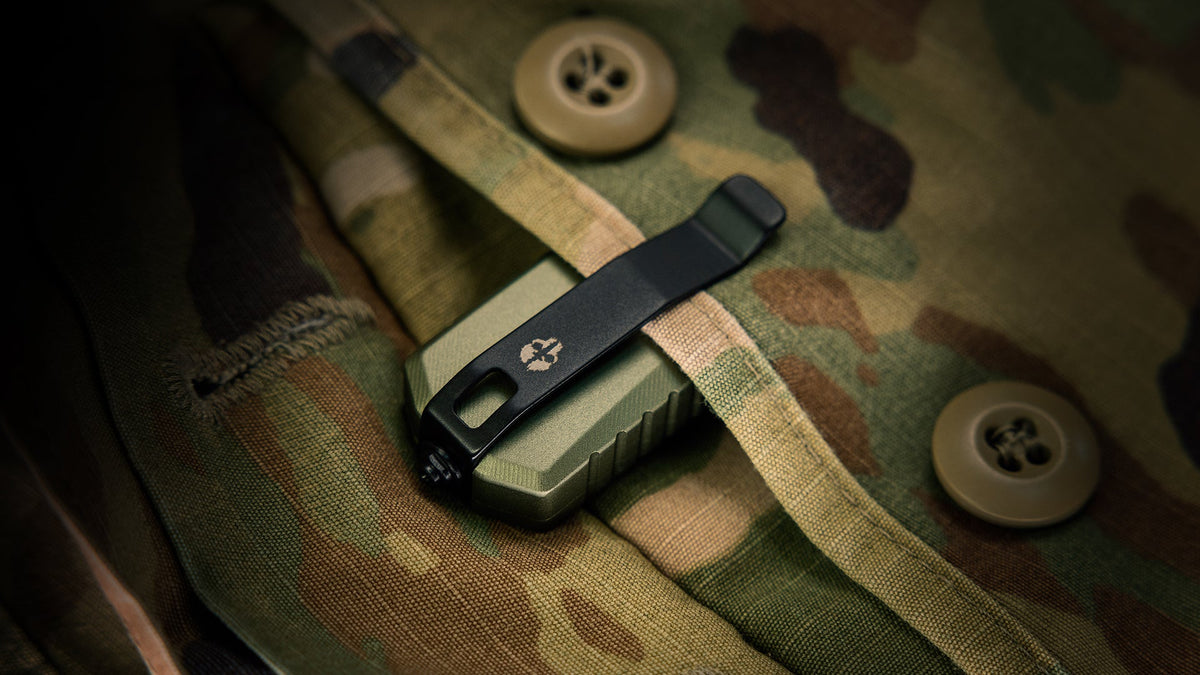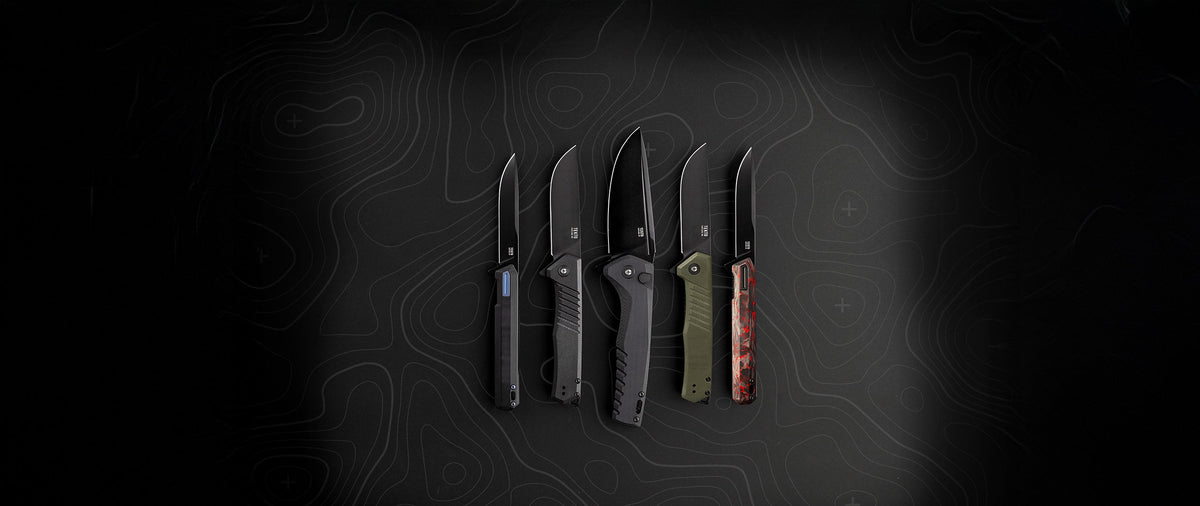


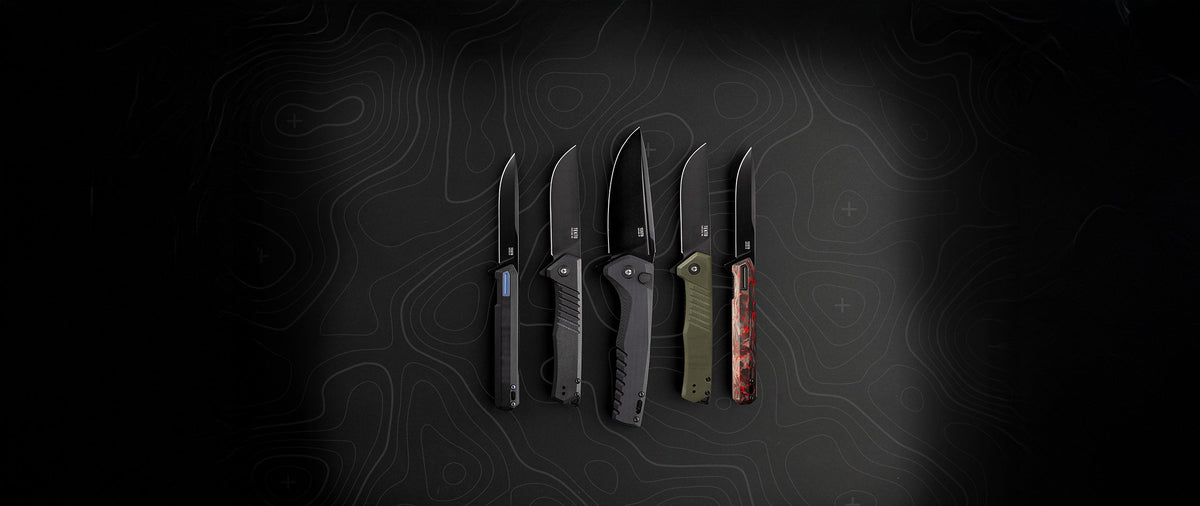
EDC stands for everyday carry, and an EDC knife is the one that goes in your pocket every morning with your keys and your phone, whether or not you expect to need it. This guide from TEKTO® explains what makes a knife good at that job: blade length and the legal lines that come with it, weight, thickness, steel, lock, opening, clip and carry position. It compares a folder, an OTF and a small fixed blade for daily carry, covers a simple EDC kit, and ends with our picks for the way you carry.
The Short Version
A good EDC knife is one you will actually carry: light enough to forget, small enough to be legal where you go, and sharp and sturdy enough for the boxes, cord, tape, food and packaging that make up almost all everyday cutting. For most people that means a folder with a 2.5 to 3.5 inch blade, a weight around 3 ounces or less, a reliable lock and a pocket clip. If you want one-handed speed in a small package, a compact OTF does it. If you want no moving parts at all, a small fixed blade on the belt. At TEKTO, the A2 Badger, our best seller, is the small OTF most people start with, the F1 Alpha and F2 Bravo are the light folders, and the X1 Atlas is the fixed blade.
What EDC Means
Everyday carry is less a kind of knife than a habit. An EDC knife is the one that is always on you, so it is judged on different things than a hunting knife or a camp knife. It has to ride in a pocket all day without being noticed, come out and open quickly when a box or a zip tie needs cutting, and go back without fuss. It should look at home in an office as well as a truck, and it has to be legal everywhere you take it.
That is why the best EDC knife is rarely the biggest or the toughest one you own. It is the one that is still in your pocket when you need it, and every choice below comes back to that.
Blade Length and the Legal Lines
Length is the first decision because it is the one the law cares about most. Most everyday cutting happens in the first inch or two of the edge, so a 2.5 to 3.5 inch blade handles nearly everything, and even a blade under 2 inches opens boxes and mail all day. Shorter blades carry more easily, look less alarming to the people around you, and clear more legal limits.
Where length limits exist, states set them, and some cities add their own. They can differ for concealed and open carry, for automatic knives, and for places such as schools. California is the best-known example: to carry an automatic knife there, the blade must be under 2 inches, which is why the A2 Badger's blade is 1.85 inches. Before you choose, look up your state, and the states you travel to, in our Knife Laws by State guide.
Weight and Size in the Pocket
Weight decides whether a knife gets carried. Around 3 ounces or less, a knife disappears in a pocket. Between 3 and 4 ounces you know it is there. Past 5 ounces it starts to drag a pocket down, and it tends to end up on the dresser. The handle matters as much as the blade: a long, thick handle shows through thin pants and digs in when you sit, so compare closed length and weight, not just blade length.
For reference, the F2 Bravo weighs 2.4 ounces, the lightest folder we make. The A2 Badger weighs 2.18 ounces with a 3.25 inch handle. The F3 Charlie, our largest folder, weighs 4.50 ounces, which is a full-size work knife rather than a pocket-and-forget one.
Blade Thickness and Grind
Thin blades cut better. A thinner blade with a high, flat grind slices cardboard, food and tape cleanly, while a thick blade with a low grind wedges in the cut and tears. Thick stock survives abuse, but an EDC knife should not be prying anything open, and a blade built to pry gives up the slicing you do every day. Pick the thinnest blade that suits how you work, and keep a small screwdriver or pry tool in your kit for the jobs a blade should not do. The F1 Alpha has a full flat grind, the grind to look for if slicing is most of what you do.
Blade Steel
Every steel is a balance of edge retention, toughness and rust resistance. In a pocket knife, edge retention and rust resistance matter most, because an EDC blade cuts a little every day and lives next to a warm, sometimes sweaty body. TEKTO uses three steels. D2, on the F1 Alpha, F2 Bravo, F3 Charlie, A2 Badger and A3 Delta, holds an edge a long time for the money and is semi-stainless, so we coat it in titanium. S35VN, on the A5 Spry, A5 Spry Mini, A7 Zastava and F4 Echo, is fully stainless and handles sweat and wet weather. MagnaCut, on the X1 Atlas and the A5 Spry Bronze, adds the best corrosion resistance and toughness of the three.
If you sweat a lot, live near salt water or never clean a knife, choose S35VN or MagnaCut. If you wipe your knife now and then, D2 does the job well. Our blade steel guide compares the common knife steels, and our D2 steel guide covers D2 in depth.
Lock and Opening
A folder's lock keeps the blade from closing on your fingers, and it shapes how the knife feels to use. A liner lock is light and simple, and you close it by pushing a sprung piece of the liner aside with your thumb. A button lock holds the blade with a sprung plunger, closes without putting a finger in the blade's path, and works the same in either hand. Our lock types guide explains every common lock and how to check one.
Opening comes next. A flipper tab on a smooth pivot opens fast with one hand, and the F1 Alpha's ceramic ball bearings make it quick and consistent. An automatic opens at the push of a button or slider, the fastest one-handed opening there is, and its legality depends on your state. A double-action OTF uses the same button to send the blade out and bring it back, so you never have to touch the blade at all.
Clip and Carry Position
The clip decides how the knife rides and how fast it comes out. A deep-carry clip lets the knife sit low in the pocket so less of it shows. Tip-up carry, with the point toward the top of the pocket when the knife is closed, is the most common setup on modern folders and brings the knife out ready to open. If you are left-handed, check whether the clip can move to the other side. The A2 Badger, A5 Spry and A5 Spry Mini all have ambidextrous clips. Where you carry matters as much as the clip: the front pocket of your dominant hand suits most people, and a waistband, a belt or a bag suits others. Our guide to the best way to carry a knife covers pockets, belts and bags in detail.
Handle Material and Grip
The handle is what you hold and what rubs against your pocket all day. G10 is a tough, textured laminate that grips well wet or dry. Carbon fiber is lighter and smoother, and forged carbon gives it a marbled look. Aluminum, which we use on most of our OTFs, is light, strong and takes a hard finish, and it feels cooler and slicker in the hand. A textured handle is worth more on a knife you use with cold or sweaty hands than a polished one. Our handle materials guide compares them all.
Legality Beyond Length
Length is only one of the lines. States also regulate by type, most often automatic knives and certain fixed blades, by how you carry, concealed or open, and by place, such as schools, courthouses and government buildings. Automatic knives, including OTFs and side-openers, are legal to own in most states, but some restrict how they are carried or how long the blade can be, and a double-edged blade can fall under different rules from a single edge. When you fly, a pocket knife goes in a checked bag, never in a carry-on. Read your state's page in our Knife Laws by State guide before you settle on a knife, because the best EDC knife is one you can carry without a second thought.
Folder, OTF or Small Fixed Blade?
All three make good EDC knives. They differ in how they carry, how they open and what they ask of you.
| Folder | OTF automatic | Small fixed blade | |
|---|---|---|---|
| Carry | Pocket clip, flat and light | Pocket clip, slim and narrow | Sheath on the belt or waistband |
| Opening | One hand, by flipper or thumb | One button, out and back | Draw it, nothing to open |
| Strength | Set by the lock, plenty for cutting | Made for cutting, not prying | Strongest, no pivot or lock |
| Upkeep | Clean the pivot now and then | Keep lint and grit out of the track | Wipe it and go |
| Legal picture | Fewest restrictions | Check your state for automatics | Check your state for concealed carry |
| Best for | Most people, and a first EDC knife | Fast one-hand use in a small package | Hard use, the outdoors, no moving parts |
| TEKTO models | F1 Alpha, F2 Bravo, F3 Charlie, F4 Echo | A2 Badger, A5 Spry Mini, A5 Spry, A7 Zastava | X1 Atlas |
A folder is the default for good reason. It carries flat, it is welcome almost anywhere, and a good one with a solid lock handles every cutting job a day brings. Our list of folding knives under $200 is a good place to compare.
An OTF gives you the fastest one-handed opening and closing there is, in a slim handle, and a compact one weighs less than most folders. It is a cutting tool, not a pry bar, and its track wants an occasional clean. Our OTF buying guide walks through what to look for.
A small fixed blade is the strongest and simplest of the three, with nothing to fold, lock or clean inside. The trade is a sheath, a little more bulk, and concealed carry rules that are stricter for fixed blades in some states.
A Simple EDC Kit
The knife is the center of an EDC kit, not the whole of it. Most people who carry a knife every day also carry a small flashlight, a pen and a lighter, alongside the keys, wallet and phone that are going in their pockets anyway. Some add a compact multitool for screwdrivers and pliers, a couple of bandages and a watch. Keep the kit small enough that all of it comes with you every day, because a kit that stays home does nothing.
One small addition makes a small knife easier to live with: a lanyard. It gives you something to grab in a deep pocket and a little more to hold on to in use. The TEKTO lanyard is 550 paracord with a titanium bead, in black, OD green or desert.
Our EDC Picks by How You Carry
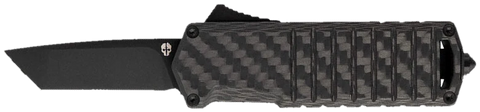
The smallest automatic: A2 Badger. Our best-selling knife and the one most people start with. The A2 Badger is a double-action OTF with a 1.85 inch titanium-coated D2 blade, in Double Edge or Tanto, a button lock, and an aluminum or carbon fiber handle. It weighs 2.18 ounces, and its blade is under the 2 inch line that matters in California. If you choose the Double Edge, check how your state treats double-edged blades first.
A small automatic in stainless: A5 Spry Mini. The same 1.85 inch size as the Badger with an S35VN blade, for carriers who sweat or work outdoors. The A5 Spry Mini weighs 2.15 ounces.
The light folder: F2 Bravo. At 2.4 ounces the F2 Bravo is the lightest folder we make, with a 3.30 inch titanium-coated D2 drop point, a flipper and a liner lock, in forged carbon or G10.
The first folder: F1 Alpha. The most affordable TEKTO and an easy first EDC knife. The F1 Alpha has a 3.10 inch titanium-coated D2 blade with a full flat grind, a flipper on ceramic ball bearings, a liner lock and a glass breaker, and it weighs 3.03 ounces.
A button lock and a stainless blade: F4 Echo. The F4 Echo pairs a 3.40 inch S35VN reverse tanto with a button lock in an aluminum frame with G10 inlays, at 2.64 ounces.
A full-size work folder: F3 Charlie. For a belt-and-boots day rather than a suit, the F3 Charlie carries a 3.80 inch D2 blade at 60 to 62 HRC and a button lock. At 4.50 ounces you will know it is there.
A full-size OTF: A5 Spry. The A5 Spry has a 3.50 inch blade in S35VN, or MagnaCut on the Bronze edition, in a 4.90 inch aluminum handle weighing 3.49 ounces. Check your state's limits for automatic blade length before you buy one.
The small fixed blade: X1 Atlas. Made in the USA, the X1 Atlas has a 3.30 inch CPM MagnaCut drop point, a full tang, a G10 handle and a Kydex sheath, at 3.88 ounces. It is the pick for hard use and for carriers who want nothing that folds.
Buying for someone else? Our gift guide matches a knife to the person and the budget.
Everyday Carry Picks
The best-selling A2 Badger OTF, the F1 Alpha and F4 Echo folders, and the X1 Atlas fixed blade.


People Are Asking
What does EDC knife mean?
EDC stands for everyday carry. An EDC knife is the knife you carry every day, usually a small folder or OTF with a pocket clip, for ordinary cutting such as boxes, cord, tape, packaging and food.
What is a good blade length for an EDC knife?
For most people, 2.5 to 3.5 inches covers nearly all everyday cutting and carries easily. Length limits vary by state and sometimes by city, so check yours first. In California, for example, an automatic knife you carry must have a blade under 2 inches.
Is an OTF knife good for everyday carry?
Yes, where automatic knives are legal. A compact OTF like the A2 Badger is slim and light and opens and closes with one thumb. It is made for cutting, not prying, and its track should be kept clear of lint and grit.
Should I carry a folder or a fixed blade?
A folder suits most people, because it carries flat in a pocket and is welcome almost anywhere. A small fixed blade is stronger and has nothing to clean inside, but it needs a sheath, and some states restrict carrying a fixed blade concealed.
What steel is best for an EDC knife?
One that holds an edge and resists rust, since an EDC knife cuts a little every day and rides close to your body. D2 gives long edge life for the money if you keep it dry. S35VN and MagnaCut are fully stainless and the better choice for wet climates or heavy sweat.
What is the best TEKTO knife for everyday carry?
The A2 Badger, our best seller, is the most popular choice: a 1.85 inch double-action OTF weighing 2.18 ounces. For a folder, the F2 Bravo is the lightest at 2.4 ounces, and the F1 Alpha is the most affordable.