

The lock is the part of a folding knife that keeps the blade from closing on your fingers, and it decides more about how a knife feels to use than most buyers realize: how you close it, whether it works in either hand, how much it weighs and how much you can trust it under load. This guide explains every common folding knife lock, from the old slip joint to the liner lock, frame lock, lockback, button lock, crossbar lock and compression lock, how to check that a lock is doing its job, and which lock each TEKTO® folder uses and why.
The Short Version
For most people the choice comes down to a liner lock or a button lock. A liner lock is light, simple and the most common lock on modern folders, and you close it by pushing a sprung piece of the liner aside with your thumb. A button lock holds the blade with a sprung plunger, keeps your fingers out of the blade's path when you close it and works the same in either hand. Frame locks, lockbacks and crossbar locks are the strong, heavier options, and a slip joint is not a lock at all. Any true lock, made well, holds far more than any hand task asks of it. TEKTO uses liner locks on the F1 Alpha and F2 Bravo and button locks on the F3 Charlie and F4 Echo.
Why a Folder Needs a Lock
A folding knife's blade turns on a pivot, which is what lets it fold away. The same pivot means that, without something to stop it, the blade will swing closed the moment pressure lands on the spine, and the edge closes toward your fingers. A lock blocks that swing by wedging something solid behind the blade's tang, the part of the blade inside the handle, until you release it. Good locks do it with no wobble, release easily on purpose and never release by accident. Our folding knife anatomy guide labels the pivot, the tang and the rest of the parts.
The Slip Joint
The slip joint is the traditional pocket knife action, older than any lock on this list. A stiff backspring runs along the spine of the handle and presses on a flat at the base of the blade, holding it open or closed by tension alone, and many slip joints stop at a half-open position on the way. Push hard enough on the spine and the blade folds. That makes a slip joint fine for light work like cutting string, opening letters and peeling fruit, and a poor choice for anything that loads the spine. It also makes it the knife of choice in places that restrict locking blades, such as the United Kingdom, where a non-locking folder with a cutting edge of 3 inches or less is the one knife most people can carry. Our crazy knife laws guide covers that rule.
The Lockback
A lockback uses a rocker bar along the spine of the handle. When the blade opens, a hook on the bar drops into a notch in the tang and holds it there. To close, you press the exposed tail of the bar on the spine, which lifts the hook out of the notch. When the release sits at the back of the handle it is called a back lock, and when it sits in the middle it is a midlock. Lockbacks are strong, simple and trusted, and the Buck 110 made them famous in the 1960s. Their drawbacks are that closing usually takes two hands and the spring that holds the bar can feel stiff. Our history of the folding knife covers how the lockback changed the pocket knife.
The Liner Lock
A liner lock uses one of the steel liners inside the handle. A section of that liner is cut and bent inward so it springs toward the blade. When the blade opens, the sprung leaf snaps sideways behind the tang and wedges it open. To close, you push the leaf back toward the handle with your thumb and fold the blade, which you can do with one hand. Liner locks are light, slim, inexpensive to make well and easy to check by eye, which is why they are the most common lock on modern folders. Their weak points are that the thumb has to sit near the blade path to release them, and that the lock face can wear slowly over years of use, letting the leaf travel further across the tang. A well-made liner lock, like those on the F1 Alpha and F2 Bravo, holds far more than everyday cutting asks of it.
The Frame Lock
A frame lock is the same idea as a liner lock, made from the handle itself. Instead of a thin liner, a section of one thick handle slab, usually titanium, is cut and bent to spring behind the tang. With much more metal in the lock, it is stronger and more stable than a liner lock, and many frame locks add a stop or stabilizer to keep the lock bar from bending past its limit. It was popularized in the late 1980s and is now standard on many premium folders. The trade-offs are weight, price and a metal handle that can be slick and cold. Our handle materials guide covers titanium and the other metals.
The Button Lock
A button lock uses a spring-loaded plunger that runs through the handle and into the tang. When the blade opens, the plunger snaps into place behind the tang, or into a hole in it, and holds the blade. Press the button and the plunger moves out of the way, so the blade can swing closed. On many designs, including ours, the same plunger also holds the blade closed until you press it, which keeps the knife shut in a pocket without relying on a detent. Because you release it with a button on the side of the handle, your fingers never sit in the blade's path, and it works the same in either hand. Button locks began on automatic knives and are now common on manual flippers too. The F3 Charlie and F4 Echo use one.
Crossbar Locks
A crossbar lock uses a hardened bar that runs across the handle, through slots in both liners, held forward by springs. When the blade opens, the bar slides behind a notch in the tang and wedges it open. To close, you pull the bar back with a thumb and finger from either side, and the blade swings closed. The design is strong, fully ambidextrous and pleasant to flick, and once you are used to it, it is one of the fastest locks to close with one hand. Benchmade made it famous as the AXIS lock, and since the original patent ran out, crossbar locks built on the same idea appear on knives from many makers under many names. Their downsides are more small parts, including springs that can break or gather lint.
The Compression Lock
A compression lock is a liner lock moved to the spine. The sprung leaf sits in a cutout at the back of the handle and wedges between a stop pin and a notch in the tang, so the load presses the lock tighter rather than pushing it aside. You release it by pressing the leaf sideways from the spine, which keeps your fingers clear of the edge. Spyderco developed and made it famous. It is strong and easy to close with one hand, and you will mostly see it on that maker's knives.
Other Locks You Will See
A few other designs show up often enough to recognize. A twist collar, like the one on the Opinel, is a ring around the bolster that you turn to block the blade open or closed. Ball bearing locks wedge a spring-loaded steel ball between the tang and a stop pin and release when you pull the ball back. Many automatics use a lockback or button lock behind the spring, and some add a safety, a switch or slider that blocks the release, like the switch on the A3 Delta. If you are unsure what you are holding, look for what moves when you close the knife: that part is the lock.
How to Check a Lock
Open the knife fully and let the lock engage on its own, without pushing it into place. Grip the handle and try to move the blade up and down at the tip. There should be no vertical play, no click or shift where the blade meets the lock, and little or none from side to side. Then look at the lock itself. On a liner or frame lock, the leaf should sit behind the tang with room to spare, not slam all the way across to the far side, and it should not stick when you push it to close. On a button lock, the button should pop fully back out when the blade opens. Keep the pivot and lock area clean, since lint and grit are the most common reasons a lock fails to seat.
Skip the spine whack, the old test of slapping the back of an open blade against a table. It tests a kind of impact a knife almost never sees in use, and it can damage a good lock. If a lock ever slips, fails to engage or develops play that was not there before, stop using the knife and contact the maker. TEKTO knives are covered by the TEKTO lifetime warranty against defects in materials and workmanship, and our folding knife maintenance guide covers cleaning and oiling the pivot and lock.
Which Lock Is Right for You
If you want the lightest, slimmest folder and do not mind closing it with your thumb near the edge, a liner lock. If you want your fingers clear of the blade path every time and a knife that works the same in either hand, a button lock. If you want the strongest lock and accept the weight, a frame lock or a crossbar lock. If you want a classic that closes with two hands and lasts forever, a lockback. And if you live under rules that ban locking blades, a slip joint. Left-handed carriers should look hardest at button and crossbar locks, which do not favor either hand, and our left-handed guide covers the TEKTO options.
Which TEKTO Knife Uses Which Lock
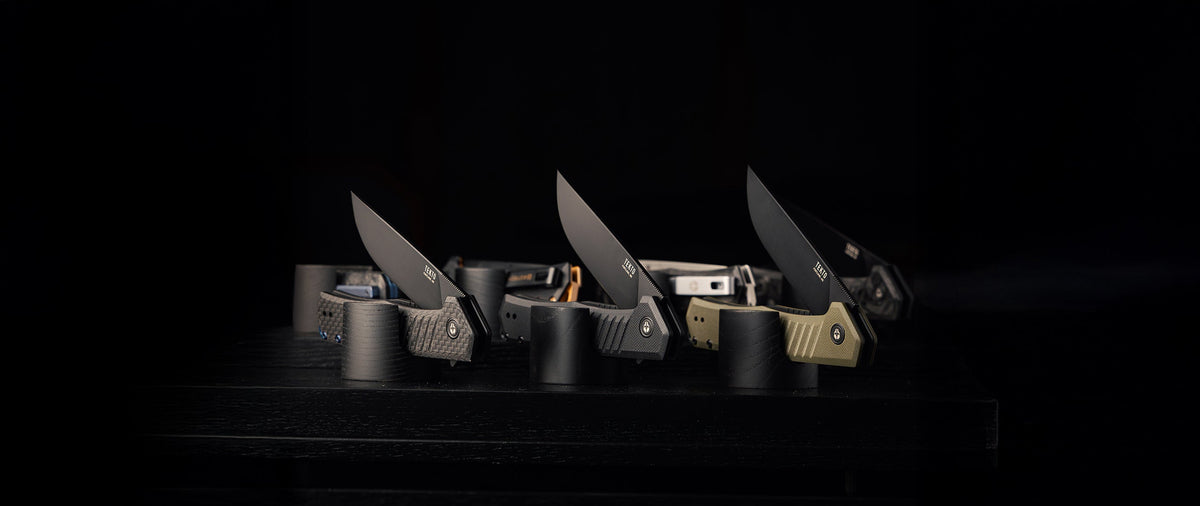
The F1 Alpha and F2 Bravo use liner locks, which keeps them light at 3.03 and 2.4 ounces, and so do their EOTECH editions. The F3 Charlie and F4 Echo use button locks that hold the blade open and closed and keep the thumb away from the edge. Our side-opening automatic, the A3 Delta, uses a button lock with a safety switch that blocks the button, and our out-the-front automatics lock the blade at full extension inside the handle, which our OTF vs side-opening guide explains. The X1 Atlas is a fixed blade and needs no lock at all. Our product guides for the F1 Alpha, F2 Bravo, F3 Charlie and F4 Echo go into each lock, and our folders under $200 page puts all four side by side.
Two Liner Locks, Two Button Locks
The F1 Alpha and F2 Bravo on liner locks, the F3 Charlie and F4 Echo on button locks that hold the blade open and closed.


People Are Asking
What is the strongest folding knife lock?
Frame locks, lockbacks and crossbar locks generally test strongest under load, because they put the most material behind the blade. A well-made liner lock or button lock still holds far more than any hand task asks of it, so for everyday carry the choice is more about handling than strength.
What is the difference between a liner lock and a frame lock?
Both use a sprung leaf that snaps behind the blade's tang. On a liner lock that leaf is cut from a thin steel liner inside the handle. On a frame lock it is cut from a thick handle slab, usually titanium, which makes it stronger and heavier.
Is a button lock better than a liner lock?
It depends on what you value. A button lock keeps your fingers out of the blade's path when closing and works the same in either hand. A liner lock is lighter, slimmer and simpler. TEKTO uses liner locks on the F1 Alpha and F2 Bravo and button locks on the F3 Charlie and F4 Echo.
Is a slip joint knife a locking knife?
No. A slip joint holds its blade open with spring tension only, so enough pressure on the spine will fold it. That makes it fine for light tasks and legal in some places that restrict locking blades, such as the United Kingdom, where a non-locking folder with a cutting edge of 3 inches or less can be carried.
How do I know if my knife's lock is safe?
Open the knife and let the lock engage on its own. There should be no vertical play at the tip, the lock should sit fully behind the tang without sliding all the way across, and it should release smoothly. If it ever slips or develops new play, stop using it and contact the maker.