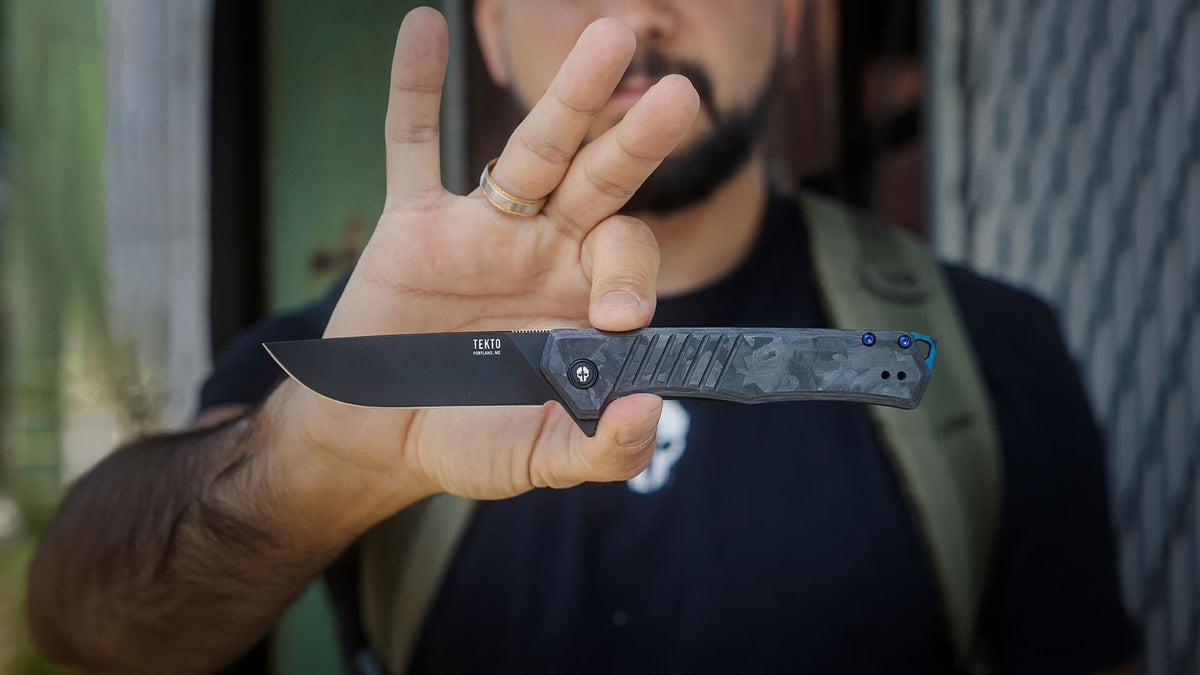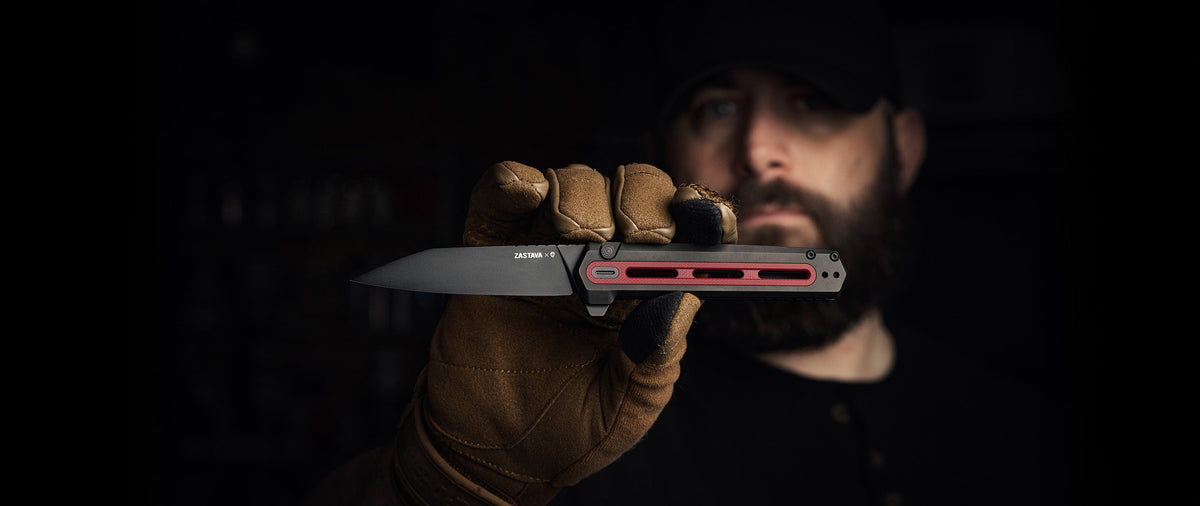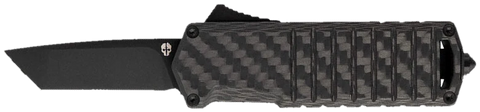


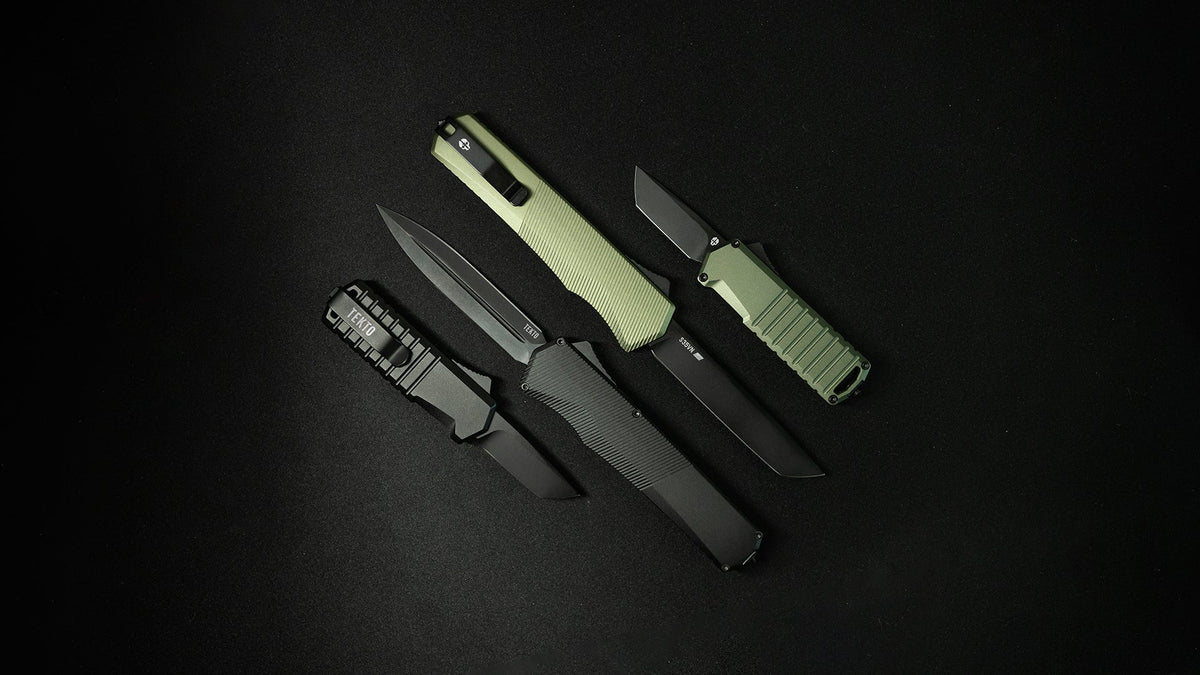
Knife people talk in shorthand: a full flat grind, a button lock, 60 HRC, a reverse tanto, double action. None of it is hard once someone explains it, and most of it matters when you choose, use or carry a knife. This glossary from TEKTO® explains the terms you will meet on product pages, in reviews and in the law, grouped the way you would look them up, with a link to our deeper guide wherever one exists.
Parts of a Knife
Blade. The steel part that cuts, from the tip to where it meets the handle. Blade length is usually measured from the tip to the front of the handle, though some state laws measure it differently.
Edge. The sharpened side of the blade. Spine. The thick, unsharpened back of the blade, opposite the edge.
Tip and point. The tip is the last half inch or so of the blade, and the point is where the edge and spine meet. A strong point has plenty of steel behind it, and a fine point pierces and does detail work.
Belly. The curved part of the edge toward the tip. More belly makes slicing and skinning easier.
Choil. The unsharpened notch or gap between the end of the edge and the handle, which makes sharpening the whole edge easier and on some knives gives a finger a place to sit.
Jimping. Small grooves cut into the spine or handle where the thumb or finger rests, for grip and control.
Tang. The part of the blade steel that extends into the handle. A full tang runs the whole length and width of the handle, which is the strongest construction for a fixed blade, as on the X1 Atlas.
Scales. The two handle slabs on either side of a knife, in G10, carbon fiber, aluminum, wood or other materials. Liners. Thin metal plates inside the scales of many folders that add strength and, on a liner lock, do the locking.
Pivot. The pin a folding blade rotates on. Its washers or bearings decide how smoothly the knife opens.
Pocket clip. The clip that holds the knife in a pocket. An ambidextrous clip can be carried on either side, and a deep-carry clip lets the knife ride low so little shows above the pocket.
Lanyard hole. A hole in the butt of the handle for a lanyard, which makes a knife easier to find and pull from a pocket. Glass breaker. A hardened point on the butt of the handle for breaking tempered side glass in an emergency, as on the F1 Alpha.
Our folding knife anatomy guide draws all of these on a real knife.
Blade Shapes and Grinds
Drop point. The spine curves down gently to meet the edge, which gives a strong point and a long belly. The most versatile everyday shape, used on the F2 Bravo, F3 Charlie, A3 Delta and X1 Atlas.
Clip point. The spine is cut away near the tip in a straight or concave line, which makes a finer, sharper point. Our drop point vs clip point guide compares the two.
Tanto. A blade whose edge runs straight and then turns up at an angle to the point, leaving a thick, strong tip for piercing. Reverse tanto. The angle is on the spine instead, so the tip stays strong while the edge keeps a continuous curve, as on the F4 Echo. See our tanto guide.
Double edge. A symmetrical blade sharpened on both sides to a centered point, sometimes called a dagger blade. TEKTO's A2 Badger, A5 Spry, A5 Spry Mini and A7 Zastava offer it.
Spear point. A symmetrical blade with a centered point, which can be sharpened on one side or both. The A7 Zastava's spear point is single-edged with a swedge.
Swedge. A bevel ground into the spine near the tip that thins the point without sharpening it.
Sheepsfoot and Wharncliffe. Blades with a straight edge and a spine that drops to meet it at the tip, giving precise control and a point that is hard to stab with by accident.
Grind. How the blade is shaped from the spine down to the edge. A full flat grind tapers evenly from the spine and slices best, as on the F1 Alpha. A saber grind starts the taper partway down and leaves a thicker, stronger spine. A hollow grind is concave and very thin behind the edge. A chisel grind is beveled on one side only. Our blade shapes guide covers the shapes in more detail.
Edges
Plain edge. A smooth edge with no teeth. Best for clean push cuts, food, paper and anything you want to cut cleanly, and the easiest to sharpen.
Serrated edge. An edge with teeth, which saws through rope, webbing and seatbelts where a plain edge skates. A partially serrated or combo edge puts the teeth near the handle and keeps a plain edge toward the tip. See serrated vs plain edge.
Edge angle. The angle of each side of the edge, measured from the center line. Pocket knives are usually sharpened at roughly 15 to 20 degrees per side. A lower angle cuts more easily, and a higher angle is more durable.
Burr. The thin curl of steel that forms on the opposite side of the edge while sharpening, a sign you have sharpened all the way to the apex. Honing and stropping. Realigning and polishing an edge on a rod or a leather strop between sharpenings. Our sharpening guide walks through the method.
Steel and Hardness
Carbon steel, stainless steel and tool steel. Carbon steels take a fine edge and rust easily. Stainless steels add chromium, roughly 12 percent or more, to resist rust. Tool steels such as D2 sit between them, with high wear resistance and some rust resistance.
D2. A semi-stainless tool steel that holds an edge well and sharpens readily. TEKTO uses it, titanium-coated, on the A2 Badger, A3 Delta, F1 Alpha, F2 Bravo and F3 Charlie. See D2 steel explained.
Powder steel. Steel made from fine metal powder pressed and fused under heat, which spreads the hard carbides evenly for a cleaner, tougher edge. CPM S35VN and CPM MagnaCut are powder steels. S35VN is on the A5 Spry, A5 Spry Mini, A7 Zastava and F4 Echo, and MagnaCut is on the X1 Atlas and the bronze A5 Spry. See our MagnaCut guide.
HRC. Hardness on the Rockwell C scale. Most good pocket knife steels run between about 58 and 64 HRC. Harder holds an edge longer, softer is tougher and easier to sharpen, and the heat treatment matters as much as the number.
Edge retention, toughness and corrosion resistance. The three properties every steel trades against each other: how long it stays sharp, how well it resists chipping and breaking, and how well it resists rust. Our blade steel guide rates the steels on each.
Heat treatment. The heating and cooling that sets a steel's hardness and toughness. The same steel can perform very differently depending on how well it was heat treated.
Coating. A thin layer applied to the blade, such as the titanium coating on most TEKTO blades, which adds color, cuts glare and adds some rust and wear resistance. See finishes and coatings.
Damascus. Today, usually steel made by layering and folding two or more steels, then etched to show the pattern. The original Damascus was a single crucible steel called wootz. "Damascus G10," as on some TEKTO handles, is a G10 laminate with a similar layered look, not steel. Our Damascus steel guide explains the difference.
Locks and Actions
Manual folder. A folding knife you open by hand, with a thumb stud, a thumb hole or a flipper. Legal in more places than any other folding knife.
Flipper. A tab on the spine that sticks out of the closed handle. Pull it with the index finger and the blade swings open. Detent. A small ball or bump that holds a folder's blade closed until you push past it.
Ball bearings and washers. What the blade turns on at the pivot. Bearings, like the ceramic ones in the F1 Alpha, make the action smoother than plain washers.
Liner lock. A spring liner inside the handle snaps behind the open blade to hold it. Used on the F1 Alpha and F2 Bravo. Frame lock. The same idea, using the handle frame itself as the spring.
Button lock. A plunger that drops into the blade when it opens and releases at the press of a button, which also holds the blade closed. Used on the F3 Charlie and F4 Echo, and on push-button side-opening automatics like the A3 Delta, where the same button releases the blade.
Lockback. A rocker bar along the spine that locks the blade open and releases when you press the back of the handle. Crossbar lock. A spring-loaded bar across the handle that blocks the blade's tang. Slip joint. A non-locking folder held open by spring tension, like a classic pocketknife. Our lock types guide compares them all.
Assisted opening. A folder with a spring that finishes opening the blade after you start it by hand. Federal law does not treat these as switchblades.
Automatic. A knife whose blade opens by a spring at the press of a button or switch. Federal law and many state laws call it a switchblade.
OTF. Out the front. An automatic whose blade fires straight out of the end of the handle, like the A2 Badger and A5 Spry. Side-opening automatic. An automatic whose blade swings out of the side like a folder, like the A3 Delta. See what OTF means and our types of automatic knives.
Double action and single action. A double-action OTF fires the blade out and retracts it with the same switch. A single-action OTF fires it out with the switch, and you close it by pulling a charging handle at the back of the knife, which draws the blade home and resets the spring. Every TEKTO OTF is double action. Our single vs double action guide explains the trade.
Safety switch. A switch that locks the firing button so an automatic cannot open by accident, as on the A3 Delta.
Blade play. Movement in an open blade. A little side to side play is normal in an OTF, which needs clearance in its track, and a folder should have almost none. Centering. How evenly a closed folder's blade sits between the handle sides.
Handles and Carry
G10. A glass-fiber and resin laminate that is light, grippy, waterproof and nearly indestructible. The most common modern handle material and the one on most TEKTO folders, the A3 Delta and the X1 Atlas.
Carbon fiber and forged carbon. Carbon fiber is woven carbon strands set in resin, very light and stiff with a woven look. Forged carbon is chopped carbon pressed into a marbled pattern. Both appear on TEKTO knives from the A2 Badger to the F3 Charlie. Our handle materials guide compares every option.
6061-T6 aluminum. A strong, light, heat-treated aluminum alloy that machines precisely. TEKTO uses it for its out-the-front automatic handles and the F4 Echo frame. Titanium. Lighter than steel, stronger than aluminum and corrosion proof, common in frame locks and hardware.
Kydex. A rigid thermoplastic molded to fit a fixed blade, so the knife clicks in and stays in. The X1 Atlas ships with one.
EDC. Everyday carry: the knife and gear you carry every day. Our carry guide covers clip positions and how to carry well.
Law Words
Switchblade. In law, usually any knife that opens automatically by a spring at the press of a button, which includes OTF and side-opening automatics. The Federal Switchblade Act of 1958 regulates moving them between states.
Gravity knife. A knife whose blade opens by gravity or a flick of the wrist and locks. New York's gravity knife law was repealed in 2019 after years of arrests over ordinary folders.
Balisong. A butterfly knife, whose two handle halves rotate around the blade. Restricted in some states.
Dirk, dagger and stiletto. Old legal terms for stabbing knives, often double-edged, that still appear in some state codes with definitions that vary from state to state.
Bowie knife. A large fixed blade with a clip point, named for Jim Bowie, and the target of a wave of American knife laws in the 1830s. Our history of American knife laws tells the story.
Ballistic knife. A knife that launches its blade from the handle. Federal law bans it, and it is the most restricted knife in the country.
Open and concealed carry. Carrying a knife where it can be seen, or hidden on your person. Many states treat the two differently, and a clip showing above a pocket does not always count as open.
Preemption. A state law that voids city and county knife rules stricter than the state's own, so one set of rules applies statewide.
Location-restricted knife. A Texas term for a knife with a blade over 5.5 inches, legal to carry except in a short list of places such as schools, courts and bars.
For what each state allows, see our Knife Laws by State guide, and before a trip, our guide to traveling with a knife.
The Terms in Steel
A full flat grind and a liner lock, a reverse tanto and a button lock, a double-action OTF, and a full-tang MagnaCut fixed blade.


People Are Asking
What does OTF mean on a knife?
Out the front. An OTF is an automatic knife whose blade fires straight out of the end of the handle at the push of a switch, like the A2 Badger and A5 Spry, instead of swinging out of the side.
What is the difference between single action and double action?
A double-action OTF fires the blade out and retracts it with the same switch. A single-action OTF fires it out with the switch, and you close it by pulling a charging handle at the back of the knife, which draws the blade home and resets the spring. Every TEKTO OTF is double action.
What does HRC mean in knife specs?
Hardness on the Rockwell C scale. Most good pocket knife steels run from about 58 to 64 HRC. Harder steel holds an edge longer, softer steel is tougher and easier to sharpen, and heat treatment matters as much as the number.
What is a full tang?
A blade whose steel runs the full length and width of the handle, with the handle scales fixed to either side. It is the strongest way to build a fixed blade, and the X1 Atlas is built that way.
What is the difference between a switchblade and an assisted-opening knife?
A switchblade, or automatic, opens by a spring at the press of a button. An assisted opener needs you to start the blade by hand before a spring finishes the job. Federal law treats them differently, and so do many states.