

Few words in the knife world carry as much romance as Damascus, and few get used as loosely. The name covers two different steels made in two different ways, a legend about swords that could cut silk in the air, a modern craft revived in the 1970s, and a lot of cheap knives with a pattern printed on the surface. This guide explains what Damascus steel is, how it is made today, how it performs next to modern powder steels, how to spot a fake, what "Damascus G10" means on a TEKTO® knife, and how to look after a real one.
The Short Version
Real Damascus is steel whose pattern runs through the metal, not over it. The original, made from wootz crucible steel, was a single steel whose pattern came from carbide bands that lined up as it was forged, and the method was lost for centuries. What is sold as Damascus today is almost always pattern-welded steel: two or more steels stacked, forge-welded, folded and etched so the layers show. It can be beautiful and it can cut well, but it performs only as well as the steels in it, and a good modern powder steel such as MagnaCut or S35VN will hold an edge longer and resist rust better. Buy Damascus for the craft and the look, from a maker you trust, and treat it like the carbon steel it usually is.
Two Things Called Damascus
The first Damascus was wootz, a high-carbon crucible steel made in southern India and Sri Lanka and forged into blades in the Middle East. The second is pattern-welded steel, a layered steel made in Europe from late Roman times through the Viking Age and revived by modern bladesmiths. Both show flowing light and dark patterns, which is why they share the name, but they are made in completely different ways. The name itself probably comes from the city of Damascus, where Europeans first met the blades in trade and war, though some trace it to an Arabic word for water, after the rippled look of the steel.
Wootz: The Original Damascus Steel
Wootz was made by sealing iron with carbon-rich material in clay crucibles, melting it, and letting it cool slowly into small cakes of very high-carbon steel. Smiths forged those cakes at low heat, carefully, into blades. As the steel was worked, bands of hard iron carbide lined up into the wavy pattern known as the watering, and the blades combined a hard, keen edge with surprising toughness. By the 1700s the ore, the trade and the know-how had faded, and for a long time the steel could not be reproduced.
Modern science has filled in much of the story. In the 1990s, metallurgist John Verhoeven and bladesmith Alfred Pendray showed that tiny amounts of elements such as vanadium in the original Indian ore helped the carbide bands form, which helps explain why the steel could not be made once those ore sources ran out. In 2006, researchers in Germany reported carbon nanotubes and carbide nanowires inside a 17th-century Damascus sabre, a structure no smith of the time could have seen or named. Smiths can make wootz-style crucible steel again today, but it is rare, slow and expensive, and you will not find it on a production knife.
Pattern Welding: How Modern Damascus Is Made
Almost every Damascus blade sold today is pattern welded. The smith stacks thin bars of two steels that etch differently, most often a high-carbon steel such as 1084 or 1095 and a nickel-bearing steel such as 15N20. The stack is heated to welding temperature and hammered or pressed until the layers fuse into one solid billet. The billet is then drawn out, cut, restacked and welded again, and each round multiplies the layer count, from a few dozen layers to several hundred.
Once the blade is ground and heat treated, it goes into an acid bath, usually diluted ferric chloride. The high-carbon layers darken and the nickel-rich layers stay bright, and the pattern appears. Without that etch, a polished Damascus blade looks almost like plain steel. Stainless Damascus works the same way with stainless steels, which are harder to forge-weld, and some of it is made by powder metallurgy rather than at the forge, which gives a cleaner, more consistent result.
Done well, the welds are invisible and the steel behaves as one piece. Done badly, the layers can hold small voids or slag, called inclusions, or separate along a weld line under stress, which is why the maker matters more with Damascus than with most steels.
The Patterns and How They Are Made
The pattern is decided at the forge. Random pattern, the most common, is simply the layers left to flow as they were folded, and it looks like wood grain. Ladder pattern is made by grinding or pressing grooves across the billet and then flattening it, which leaves rungs of repeating rings. Raindrop is made the same way with round dimples, and it leaves a field of small circles. Twist is made by twisting a square bar along its length before forging it flat, which gives a braided or star pattern. Mosaic Damascus, the most complex, is built by cutting a patterned billet into tiles and welding them back together in a design, and it can carry shapes, letters or images through the steel. More complex patterns take more welds and more time, which is most of the reason they cost more.
How Damascus Performs
A Damascus blade performs like the steels it is made of, at the hardness its heat treatment gives it. The common 1084 and 15N20 combination behaves like a good carbon steel: tough, easy to sharpen, able to take a very fine edge, and quick to rust if it is left wet. Some users feel the alternating hard and soft layers give the edge a little extra bite on a slicing cut. The effect, if it is there, is small.
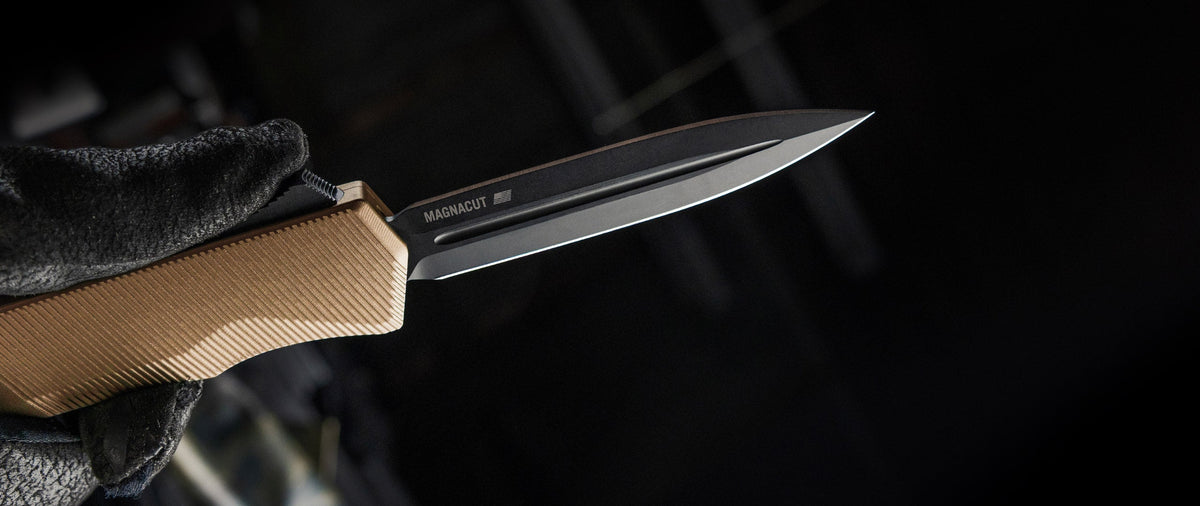
Next to modern powder steels, Damascus gives up edge retention and corrosion resistance. Powder steels like CPM MagnaCut and S35VN are made from atomized metal, so their carbides are small and evenly spread, and they are alloyed for exactly the properties a working knife needs. A MagnaCut blade like the X1 Atlas will outlast most Damascus at the edge and shrug off salt and blood that would spot a carbon Damascus in an afternoon. That is not a knock on Damascus, which is about craft and beauty first. It is a reason to choose it for the right reasons. Our blade steel guide compares the steels TEKTO uses, and the D2 steel guide explains the tool steel in most of our folders.
How to Spot Fake Damascus
The most common fake is a plain blade with a Damascus pattern laser-etched, acid-stenciled or printed on its flats. It looks the part in a photo and fails a close look. On real Damascus the pattern runs through the steel, so you can see the layers on the spine, on the edge bevel and on the tip, and they flow continuously around the shape of the blade. On a fake, the pattern stops at the bevel, the spine is plain, and the design often repeats exactly or sits too crisply on the surface, like a decal. A fake also loses its pattern wherever it is sharpened or scratched, while real Damascus shows the layers in the fresh metal.
Price is the other tell. Forge-welding, folding and etching a billet by hand takes many hours, and a hand-forged Damascus blade from a known maker carries that cost. A "Damascus" folder for the price of a lunch is either etched plain steel or mass-produced layered steel with an unknown heat treatment. If you want Damascus, buy from a maker who names the steels in the billet and stands behind the blade.
What Damascus G10 Means on a TEKTO
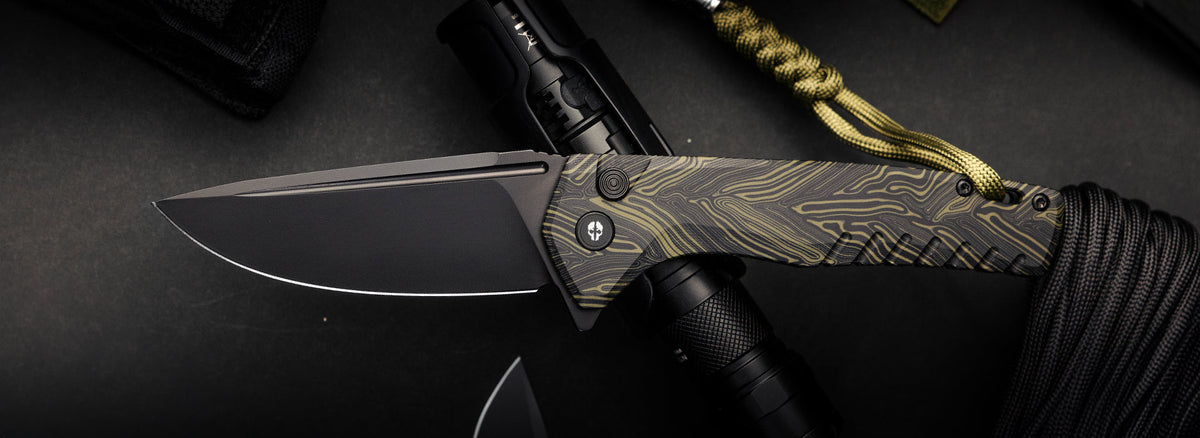
Two TEKTO folders, the F3 Charlie and the F2 Bravo, come in a handle style called Damascus G10. That is a handle material, not a blade steel. It is G10, the fiberglass and epoxy laminate on most of our folders, made from layers of contrasting G10 pressed in waves, so when the scale is machined the cut runs through the layers and leaves a flowing pattern like Damascus steel. No two scales look quite the same. The blade on both knives is titanium-coated D2, the same as the other F3 and F2 handle styles.
Because it is G10, a Damascus G10 handle needs none of the care Damascus steel does. It does not rust, it does not absorb water, it keeps its grip wet, and it cleans with soap and water. You get the look of Damascus on the part of the knife you hold, with a blade steel chosen for work. Our knife handle materials guide covers G10 and the rest of the handle materials we use.
Caring for a Damascus Blade
Most Damascus contains high-carbon steel, so care starts with keeping it dry. Wipe the blade after every use, and dry it completely after it touches water, food or blood. Keep a thin film of oil on it, mineral oil for a kitchen knife and any light knife oil for the rest, and do not store it in a leather sheath, which holds moisture and tanning chemicals against the steel. Never put it in a dishwasher. Acidic foods like citrus, tomatoes and onions will darken the steel over time, which is a patina rather than damage, though it can mute the pattern.
Sharpen Damascus on ordinary stones the way you would any blade. The fresh bevel will show bright steel, and fine polishing can wash out some of the contrast on the flats. If the pattern fades over the years, a light re-etch brings it back, usually in diluted ferric chloride or, for a gentler result, a strong instant coffee bath, but ask the maker first, since they know the steels and the etch they used. Our sharpening guide and folding knife maintenance guide cover the general routine, and the finishes and coatings guide explains why most working knives wear a coating instead.
Is Damascus Worth It
For a collector, a gift or a knife meant to be handed down, a well-made Damascus blade is worth it for the same reason a hand-cut dovetail is: it shows the work. For a knife that gets used hard every day, in the rain, on a job site or in the field, a modern powder steel will cut longer and ask less of you. Many knife owners end up with one of each. If you want the look without the upkeep, a Damascus G10 handle on a D2 blade, like the F3 Charlie or F2 Bravo, gives you the pattern in your hand and a blade that works like the rest of the lineup.
Damascus G10 and Modern Steel
The two folders that wear Damascus G10, and the MagnaCut and S35VN knives for work that asks the most of a blade.


People Are Asking
Is Damascus steel better than regular steel?
Not by itself. A Damascus blade performs like the steels it is made of and the heat treatment it got. Most is a carbon steel mix that takes a fine edge and sharpens easily but rusts, and modern powder steels such as MagnaCut and S35VN hold an edge longer and resist corrosion better.
What is the difference between wootz and pattern-welded Damascus?
Wootz was a single high-carbon crucible steel from India and Sri Lanka whose pattern formed from carbide bands as it was forged. Pattern-welded Damascus is two or more steels stacked, forge-welded and folded, with the pattern revealed by an acid etch. Nearly all Damascus sold today is pattern welded.
How can I tell if a Damascus knife is fake?
Look at the spine, the edge bevel and the tip. On real Damascus the layers run through the steel and show everywhere. On a fake the pattern is etched or printed on the flats only, stops at the bevel, and disappears where the blade is sharpened or scratched. A very low price is another warning sign.
Does Damascus steel rust?
Most does, because it usually contains high-carbon steel. Wipe it dry after use, keep a light film of oil on it, keep it out of the dishwasher and out of leather sheaths for storage. Stainless Damascus exists and is more forgiving, but it costs more.
Is the Damascus G10 on a TEKTO knife made of steel?
No. Damascus G10 is a handle material: layers of contrasting G10 pressed in waves so the machined scale shows a Damascus-like pattern. It does not rust and cleans with soap and water. The blades on the F3 Charlie and F2 Bravo are titanium-coated D2.