

A knife that is perfectly legal on your belt at home can be confiscated at an airport, be illegal to keep in the next state's center console, or be seized at a border. The rules change at every line you cross, and no single law covers a knife from your front door to your destination. This guide from TEKTO® walks through flying, driving, the federal law on moving automatic knives between states, national parks and federal buildings, hunting and fishing trips, and Canada and the rest of the world, so you can pack once and stop worrying about it.
The Short Version
No knife goes in a carry-on bag, but almost any knife can go in a checked bag if it is sheathed or wrapped. In a car, the law of the state you are in at the moment is the law that counts, so a knife that is legal at home but not where you are driving belongs out of reach, ideally locked in the trunk. Automatic knives are legal to own in most states and banned in a few, and a federal law from 1958 regulates moving them between states, which a federal appeals court called into question in October 2026. National parks follow the knife law of the state they sit in, federal buildings allow a pocket knife with a blade under 2.5 inches, and Canada treats many folders as prohibited at the border. Check our Knife Laws by State guide for every state on your route before you leave.
Flying: Carry-On and Checked Bags
The TSA does not allow knives in carry-on bags. The only exception is plastic cutlery and round-bladed butter knives, which leaves out every pocket knife, multi-tool blade and automatic. Blade length does not matter, and neither does how small or ordinary the knife looks.
Checked bags are a different story. The TSA allows knives in checked luggage and asks that any sharp object be sheathed or securely wrapped so it cannot injure the baggage handlers and inspectors who may open the bag. A folder closed inside a pouch, a fixed blade in its sheath, or any knife wrapped in a thick cloth and packed in the middle of the bag all qualify. A locked hard case is the best answer for an expensive knife, since a checked bag can be opened for inspection.
Two more points. The TSA decides what gets on the plane, not whether the knife is legal where you land, so the destination's law still applies when you pick up your bag. And on an international flight, the destination country's customs rules apply too, which we cover below.
If You Forget It at the Checkpoint
It happens to everyone who carries a knife every day. If the knife is found in your carry-on, you usually get a few choices: take it back to your car, hand it to someone who is not flying, mail it to yourself if the airport offers a mail-back service, or surrender it to the TSA, in which case you will not see it again. If you have time, the car is the best of those. The simplest prevention is a habit: before you leave for the airport, take the knife out of your pocket and put it in the checked bag or leave it at home.
Driving Across State Lines
When you drive, you are subject to the knife law of each state you pass through, in the order you pass through it. A knife that is legal to carry in Texas can be illegal to possess in a neighboring state, and passing through is generally not a defense. There is no federal law that protects people moving a knife between two places where it is legal, the way federal law does for firearms. A bill called the Knife Owners' Protection Act, which would create that protection, was introduced again in Congress in 2025 and has not become law.
The state laws that most often catch travelers are automatic knife bans, blade length limits for carry, and concealed carry rules. Five states still ban automatic knives outright: New York, New Jersey, Minnesota, Washington and New Mexico. Some cities add rules of their own. New York City, for example, adds a 4-inch limit and a ban on carrying a knife in open view. Our 50-state guide lists each state's rules, and the state pages quote the statutes.
Storing a Knife in the Car
In many states, a knife within reach of the driver counts as being carried, and a knife in a closed console or under the seat can count as concealed. That matters most when you cross into a state where your knife is restricted. The conservative way to drive through one is the way the Knife Owners' Protection Act would require if it ever passes: the knife out of reach of anyone in the passenger compartment, ideally in a locked case in the trunk, or in a locked container if the vehicle has no trunk. It costs nothing to do and it answers the first question an officer will ask.
Keep the knife's purpose obvious too. A folder in a tackle box on the way to a lake, or a fixed blade packed with hunting gear, reads differently than a knife in a jacket pocket on the dashboard.
The Federal Switchblade Act and the Fifth Circuit
The Federal Switchblade Act of 1958 has two parts that matter to travelers. Section 1242 makes it a federal crime to knowingly introduce, manufacture for introduction, transport or distribute a switchblade in interstate commerce, which in federal law includes automatic knives. Section 1243 bans making, selling or possessing them in federal territories, tribal lands and other places under special federal jurisdiction. The act has exceptions, including one for a knife with a spring or detent that biases the blade closed and needs a push on the blade to open, which keeps assisted-opening knives out of it, and one for a person with only one arm carrying a blade of 3 inches or less.
On October 21, 2026, the U.S. Court of Appeals for the Fifth Circuit ruled in Knife Rights v. Blanche that Section 1242 violates the Second Amendment, and sent the case back to the district court in Texas. The law stays in place while that happens, the decision binds federal courts only in Texas, Louisiana and Mississippi, and the government can still ask for further review. Our post on the Fifth Circuit ruling explains what the court decided, and Knife Law Watch follows the case as it moves. For a trip, the practical point is unchanged: the law of the state you are standing in decides whether you may own and carry an automatic, and the federal law is about moving them across state lines and onto a short list of federal places.
National Parks, Federal Buildings and Military Bases
National parks. The National Park Service's regulation on what visitors may carry does not list knives. It covers firearms, bows, slingshots and other things that discharge missiles, plus anything the state where the park sits prohibits. In practice, a knife that is legal in the state is legal in the park, and a knife that is illegal in the state is illegal in the park. Visitor centers and ranger stations are federal buildings, which brings the next rule into play.
Federal buildings. Federal law, 18 U.S.C. 930, bars what it calls a "dangerous weapon" from buildings the federal government owns or leases where federal employees work, and it expressly excludes a pocket knife with a blade of less than 2.5 inches. The 1.85-inch blades on the A2 Badger and A5 Spry Mini are under that length, but security at a given building has the last word on what gets through screening. Courthouses are the exception to plan around: they screen visitors and can refuse any knife, so leave it in the car.
Military bases and tribal lands. These can fall under Section 1243 of the Switchblade Act and under their own rules. If you are visiting a base, ask your sponsor or the visitor center what you can bring before you arrive.
Hunting and Fishing Trips
A hunting or fishing license does not change what knife you may carry. Some state knife laws carve out exceptions for hunting and fishing. Read them closely, since an exception for the activity does not always cover the drive there. Pack the field knife with the rest of the gear, sheathed and out of reach, and carry it once you are at camp or on the water. A fixed blade like the X1 Atlas in its Kydex sheath is the easiest knife to pack this way, and it does the dressing and cleaning work a folder should not. Our hunting knife guide and Knives Outdoors page cover what to bring.
Canada and International Travel
Canada is the border where knife owners most often lose a knife. Canadian law prohibits knives that open by gravity or centrifugal force, and since 2018 the Canada Border Services Agency has applied that to any knife whose blade can be opened with a flick of the wrist, which takes in many flippers and assisted openers along with every automatic. A knife that fails the officer's test is seized and rarely comes back. We do not ship automatic knives to Canada for the same reason, and if you are driving north, the safest plan is a stiff manual folder or a fixed blade, packed where you can show it if asked. Our Crazy Knife Laws Around the World post covers Canada, the UK, Japan and Germany in more detail.
Elsewhere, assume the rules are stricter than at home. The UK allows a non-locking folder with a cutting edge of 3 inches or less without a reason and asks for a good reason for anything else, Japan restricts carry of blades over 6 centimeters, and much of Europe has rules on locking or one-hand-opening knives. Look up the destination country's customs and carry rules before you pack, and when in doubt, leave the knife at home and buy a simple one locally.
Which TEKTO Knives Travel Best
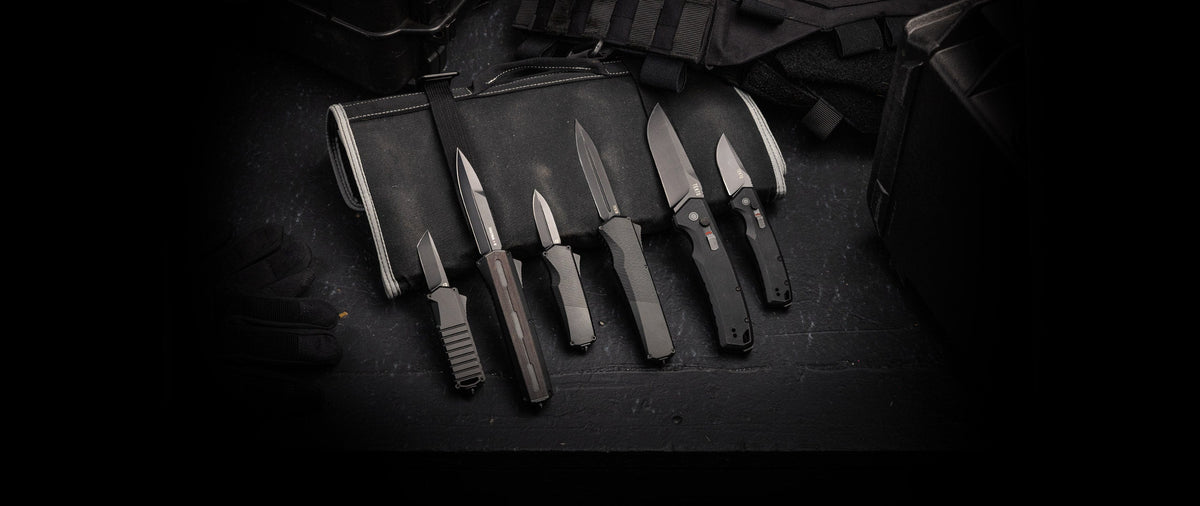
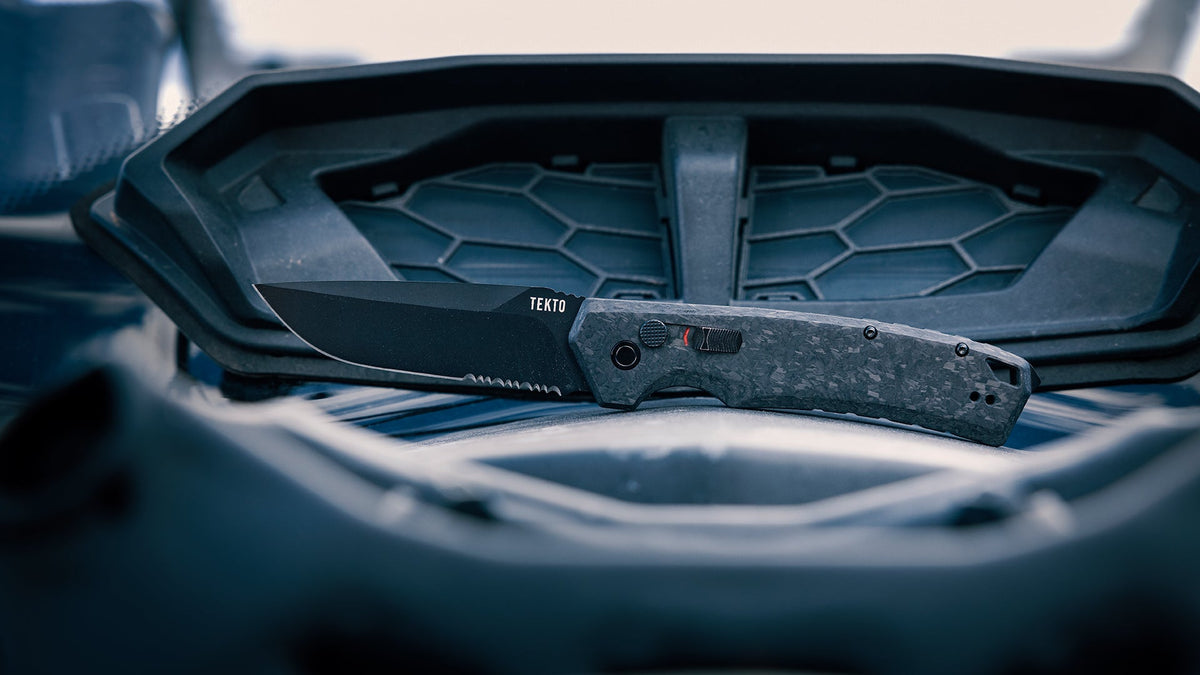
A manual folder is legal to carry in more places than any other kind of knife, which makes the F1 Alpha and the 2.4-ounce F2 Bravo the easiest TEKTO knives to take across state lines. If you carry an automatic, the 1.85-inch A2 Badger and A5 Spry Mini stay under the 2-inch line in California and under the 2.5-inch federal building limit, though they are still automatics wherever automatics are banned. And for a trip built around the outdoors, the X1 Atlas packs flat in a checked bag in its sheath. Our carry guide covers clip position and the places no knife goes.
This guide explains the law in general terms. It isn't legal advice. If you have a question about a specific trip, check the statutes for each state on your route or ask a lawyer licensed there.
Knives That Travel Well
Two manual folders legal in more places than any automatic, the small Badger, and the fixed blade that packs flat in a checked bag.


People Are Asking
Can I bring a pocket knife on a plane?
Not in a carry-on. The TSA bans every knife from the cabin except plastic cutlery and round-bladed butter knives, whatever the blade length. Knives are allowed in checked bags if they are sheathed or securely wrapped.
Can I put an automatic knife in my checked luggage?
The TSA allows knives in checked bags, but it does not decide whether the knife is legal where you land. Automatics are banned in a few states, and the federal Switchblade Act regulates moving them between states, so check both ends of the trip first.
Is it legal to drive through a state where my knife is banned?
Each state's law applies while you are in it, and there is no federal safe-passage law for knives. Keep a restricted knife out of reach, ideally locked in the trunk, and check every state on the route in our Knife Laws by State guide.
Can I bring a knife into a national park?
Generally yes, if it is legal in the state the park is in. The Park Service's rule does not list knives but includes anything the state prohibits. Visitor centers are federal buildings, where a pocket knife with a blade under 2.5 inches is allowed.
Can I take my knife to Canada?
Only if it does not open by gravity, centrifugal force or a flick of the wrist. Canada prohibits automatics and has applied that to many flippers and assisted openers since 2018. A stiff manual folder or a fixed blade is the safe choice.