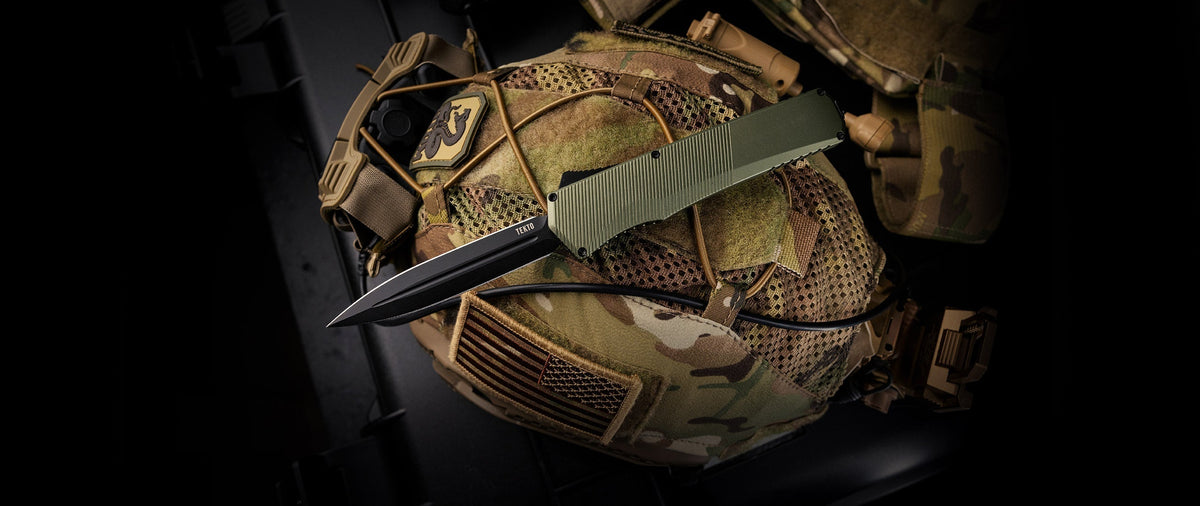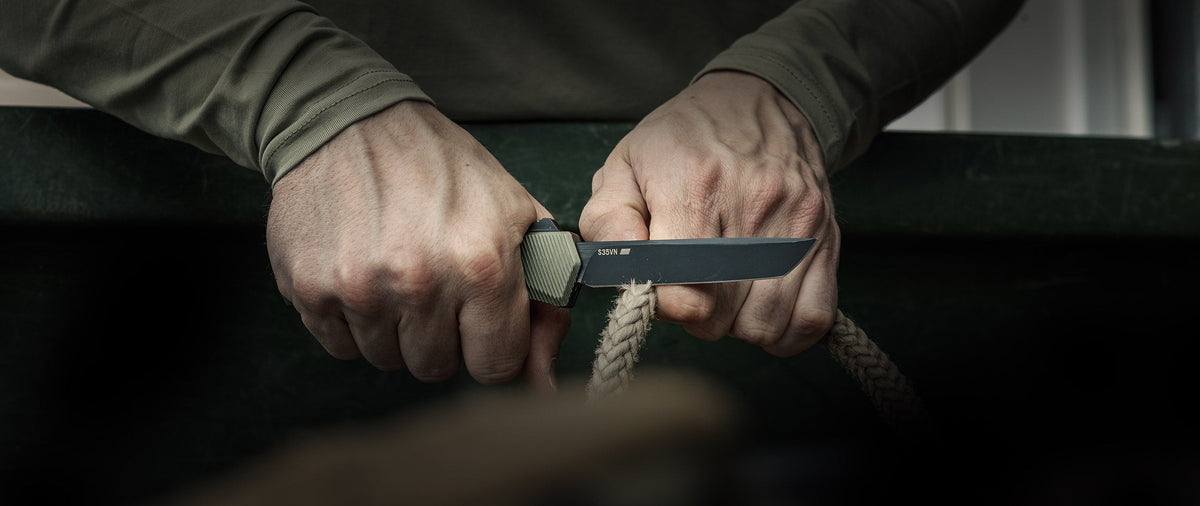


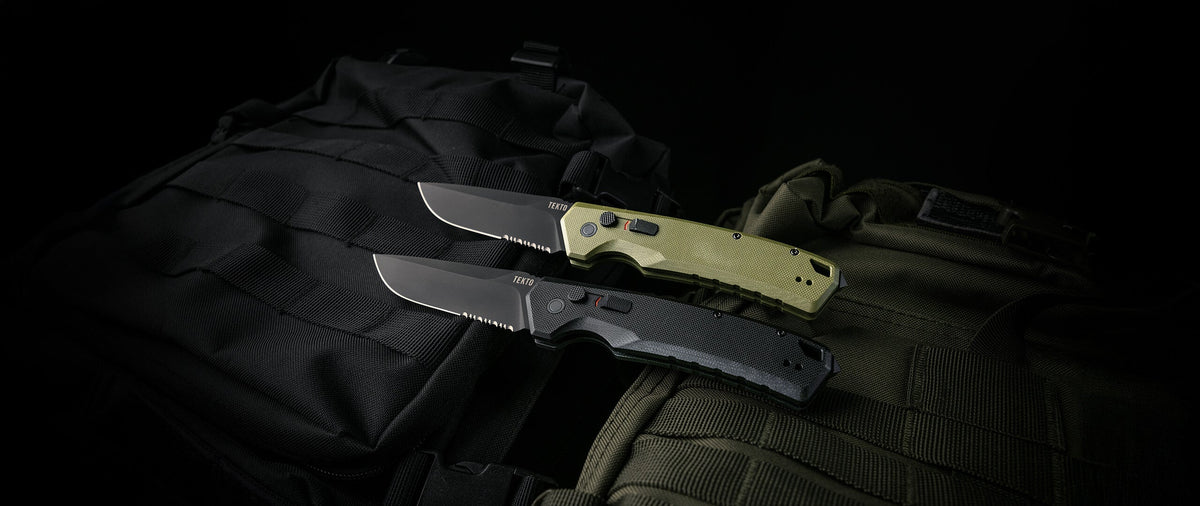
An automatic knife opens itself on a spring at the press of a button, and it comes in two basic forms. A side-opening automatic swings its blade out of the side of the handle like a folding knife. An out-the-front automatic, or OTF, fires its blade straight out of the front. Both are automatics in the eyes of the law, and both are fast, but they lock, carry, grip and clean very differently. This guide compares the two on everything that matters when you choose one, and explains where the TEKTO® A3 Delta fits beside our A5 Spry and A2 Badger.
The Short Version
Choose a side-opening automatic if you want the strongest lockup, a thicker blade, a handle shaped to fill the hand and the easiest knife to use in heavy gloves. Choose an out-the-front automatic if you want the slimmest, lightest knife for its blade length and one that opens and closes with the same thumb, in either hand, without your fingers ever going near the edge. For hard work in gloves, the side-opening A3 Delta. For everyday carry in a pocket, the out-the-front A5 Spry, or the A2 Badger if you want it small.
How a Side-Opening Automatic Works
A side-opening automatic is built like a folding knife, with a blade that turns on a pivot, plus a spring that does the swinging for you. When the knife is closed, the spring is loaded and a lock holds the blade in the handle. Press the button and the lock releases, the spring swings the blade out on its pivot, and a lock catches it fully open. To close it, you press the button again and fold the blade back into the handle with your fingers, which loads the spring for the next opening. Because the spring sits loaded in your pocket, a good side-opener has a safety. On the A3 Delta it is a switch that blocks the button, so the blade cannot fire until you move it. Almost all side-openers are single action: the spring opens the knife and you close it.
How an Out-the-Front Automatic Works
An OTF keeps its blade in a straight track inside the handle. On a double-action OTF like every TEKTO OTF, a slider on the face of the handle connects to the spring. Push it forward and the spring loads and fires the blade out of the front, where latches lock it. Pull it back and the spring fires the blade home. At rest, open or closed, the spring is relaxed. Some OTFs are single action, firing out with a button and closing by hand, and our single vs double action guide explains the difference.
Lockup and Blade Strength
This is the side-opener's clearest advantage. Its blade turns on a pivot and locks the way a good folder does, with a solid lock behind the tang, so it has the strongest lockup of any automatic and no blade play. Because the blade only has to fit the handle, not slide through a track, it can also be thicker and wider. The A3 Delta carries a 3.60-inch D2 drop point hardened to 60 to 62 HRC, and it is the automatic we would pick for breaking down boxes and cutting heavy strapping all day.
An OTF blade has to slide through a channel, so it is thinner than a folder's, and a double-action OTF has a small amount of side-to-side play at the tip, which is normal for the design. That play never affects cutting, and an OTF blade is more than strong enough for everyday work, but if you plan to bear down hard on a cut or twist the blade, the side-opener is the better tool.
Grip, Gloves and Ergonomics
A side-opener's handle can be shaped like a folder's, with curves, a finger groove and texture where the hand needs it, and the button can be large and easy to find. The A3 Delta's handle is 5.20 inches long in G10 or forged carbon, with a button and safety switch you can work in work gloves, which is why it is the automatic in our first responders guide. An OTF handle is a straight, slim tube, because it houses the blade's track, so it fills less of the hand. A textured OTF slider works fine with bare hands and thin gloves, but the bigger the glove, the more a side-opener's button makes sense.
Opening and Closing
Both open just as fast. The difference is closing. A double-action OTF closes with the same thumb that opened it, in either hand, with your fingers nowhere near the edge, and it is ready to carry again in a second. A side-opener closes with a press of the button and a fold of the blade, which takes a moment longer and puts your fingers near the back of the blade as it swings home. Neither is hard to learn, but if you open and close a knife fifty times a day, an OTF saves a lot of small motions. OTFs are also equally easy in either hand, while side-openers depend on the clip and button layout, and our left-handed guide covers how the TEKTO knives work for lefties.
Carry and Size
For the same blade length, an OTF is slimmer, narrower and lighter. The A5 Spry carries a 3.50-inch blade in a 4.90-inch handle 0.48 inches thick and weighs 3.49 ounces. The A3 Delta carries a 3.60-inch blade in a 5.20-inch handle 0.54 inches thick and weighs 5.96 ounces. That difference is the whole story of the two designs: the side-opener spends its extra size and weight on strength and grip, and the OTF spends its slimness on carry. If you want an automatic small enough for a coin pocket or a keychain, the 1.85-inch A2 Badger and A5 Spry Mini are OTFs. Our OTF blade length guide helps you choose a size, and the carry guide covers clip position.
Cleaning and Care
A side-opener cleans like a folder. Open it, rinse the pivot and the handle under warm water with a little dish soap, dry it completely, and put a drop of oil on the pivot. An OTF needs a little more thought, because lint and grit collect in the blade's track and are the most common reason it fires short. Blow the track out with compressed air, add one drop of light oil where the blade enters the handle, cycle it and wipe off the excess. Do not open an OTF's handle yourself. Our OTF cleaning guide and folding knife maintenance guide cover both routines, and the OTF reset guide covers what to do if an OTF stops short.
Safety in the Pocket
A side-opener stores its spring loaded whenever the knife is closed, which is why a safety matters on one. Make a habit of setting the A3 Delta's safety switch before the knife goes back in your pocket, and carry it so the button is not pressed by your leg, a seat belt or the edge of a bag. A double-action OTF sits with its spring relaxed, so a bump on the slider has to push it all the way past the trip point before anything happens. With either type, know where the front of the knife is pointing before you press the button, and keep your other hand clear of the blade's path. Our knife handling safety guide covers the rest.
What the Law Says
In almost every case, the law treats the two the same. Federal law and most state laws define a switchblade by how it opens, a blade that springs open from the handle at the press of a button, and that covers side-openers and OTFs alike. Where automatics are legal, both are, and where they are limited, the limits are usually by blade length, not by direction. California, for example, allows an automatic with a blade under 2 inches, whichever way it opens. Assisted-opening knives, which need a push on the blade before a spring takes over, are a separate category and are not switchblades under federal law. Check your state in our Knife Laws by State guide before you buy. This guide explains the law in general terms and is not legal advice.
A3 Delta vs A5 Spry and A2 Badger
The A3 Delta is our side-opening automatic: a 3.60-inch titanium-coated D2 drop point, plain or serrated, a button lock with a safety switch, and a G10 or forged carbon handle that fills a gloved hand. It is the one for first responders, tradespeople and anyone who uses a knife hard. The A5 Spry is our everyday OTF: a 3.50-inch blade in S35VN, or MagnaCut in the bronze edition, in a slim aluminum handle at 3.49 ounces, with double edge, drop point or tanto blades. The A2 Badger is our best seller, a 1.85-inch double-action OTF at 2.18 ounces that goes everywhere. And the A7 Zastava is the OTF with wood inlays, made with Zastava Arms USA.
Which One Is Right for You
If your knife works for a living, cutting rope, webbing, seatbelts and strapping, often in gloves, choose the side-opener. If your knife rides in a pocket and opens boxes, tape, mail and packaging all day, choose the OTF, which carries slimmer and closes faster. If you are not sure, think about how you will close it, since that is the motion you will repeat the most. Our types of automatic knives guide covers the stiletto and the rest of the family, and the OTF buying guide helps you choose between our out-the-front models.
One Side-Opener, Three OTFs
The A3 Delta for gloved, heavy work, and the A5 Spry, A2 Badger and A7 Zastava for slim everyday carry.
-
-
-
-

LOW ON STOCK


People Are Asking
What is the difference between an OTF and a side-opening automatic?
A side-opening automatic swings its blade out of the side of the handle on a pivot, like a folding knife with a spring. An OTF fires its blade straight out of the front of the handle along a track. Both open at the press of a button and both count as automatic knives under the law.
Which is stronger, an OTF or a side-opener?
The side-opener. Its blade locks on a pivot like a folder's, with no blade play, and it can be thicker and wider because it does not have to slide through a track. An OTF is strong enough for everyday cutting, but a side-opener like the A3 Delta is the better choice for hard use.
Is an OTF or a side-opener better with gloves?
A side-opener, usually. Its handle can be shaped to fill the hand and its button can be larger. The A3 Delta's button and safety switch work in work gloves. A textured OTF slider works with bare hands and thin gloves.
Are side-opening automatics legal where OTFs are?
Almost always the law treats them the same. Federal law and most state laws define a switchblade by how it opens, not which direction, so limits are usually by blade length. Check your state in our Knife Laws by State guide.
Which TEKTO knives are OTFs and which are side-opening?
The A3 Delta is our side-opening automatic. The A2 Badger, A5 Spry, A5 Spry Mini and A7 Zastava are double-action OTFs that open and close with one thumb.