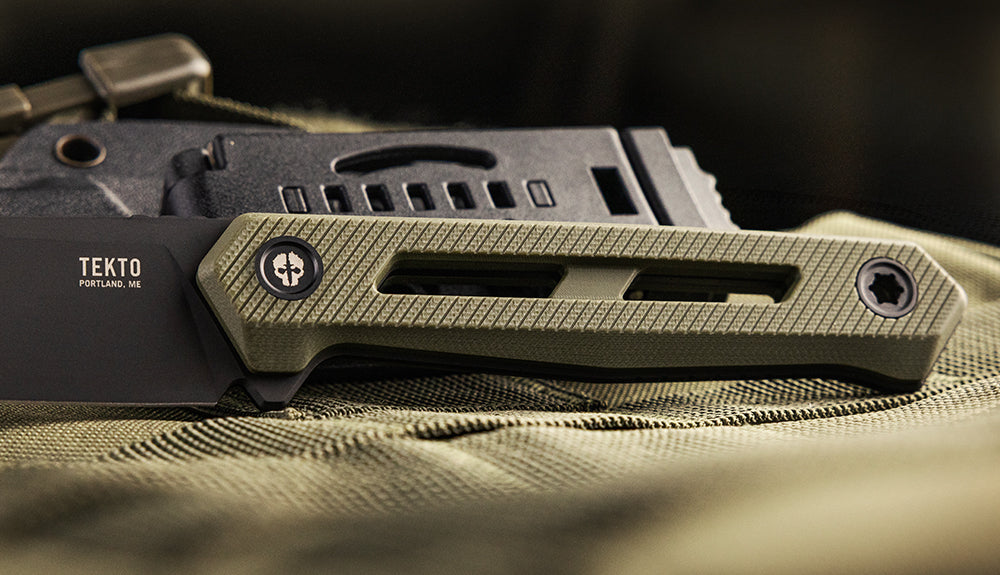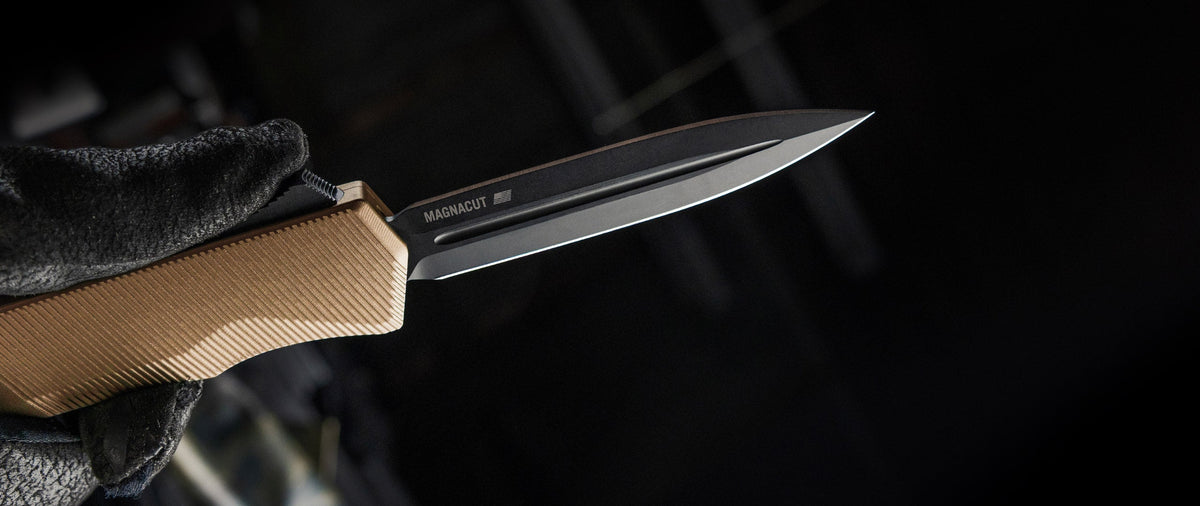


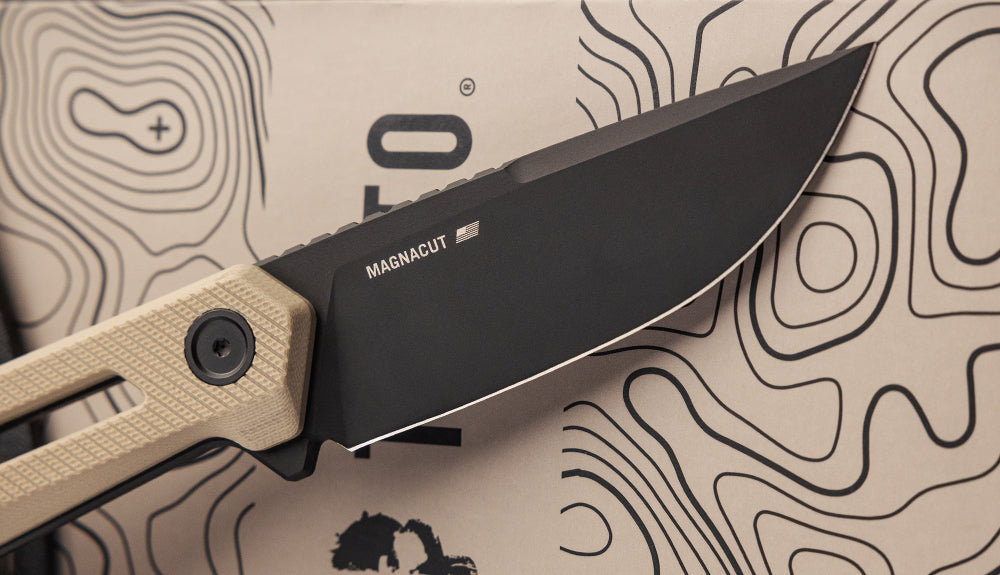
Line, braid, bait, rope and the catch itself all need a blade, and no single knife does all of it well. This guide from TEKTO® covers what the knife on your belt actually does on the water, which steels survive salt, serrated or plain, fixed, folding or automatic, what a fillet knife is and how to use one, ice fishing, dive knives, and where our knives fit and where they do not.
The Short Version
You need two knives to fish, not one. The first lives on you: a 3 to 3.5 inch fixed blade or folder in a steel that resists rust, for cutting line and braid, trimming bait, clearing a snagged rig, cutting rope and everything else a day on the water throws up. The second lives on the boat or at the cleaning table: a long, thin, flexible fillet knife, fully stainless, for turning the catch into dinner. TEKTO does not make fishing knives, and we do not make a fillet knife. What we can tell you is that owners take the X1 Atlas fishing and come back happy with it, because its CPM MagnaCut blade shrugs off salt and a fixed blade rinses clean. Buy a dedicated fillet knife and never ask a pocket knife to do its job.
What the Carry Knife Does All Day
Most of what a fishing knife cuts is not fish. It cuts monofilament and fluorocarbon leader when you re-rig, and braided line, which is tougher than it looks and chews through a dull edge. It trims bait: cut bait into strips, a squid into rings, a minnow in half. It cuts anchor line, dock line and the rope that is wrapped around a prop when it should not be. It opens packaging, cuts tangles out of a reel, clears a hook from a net, slices a lemon for lunch and shaves tinder for a fire on the bank. All of that wants a strong tip, a plain edge with some belly, a grip that works wet and slimy, and a steel that is still clean after a week of salt spray. None of it wants a 7-inch flexible blade.
Steel, Salt and Rust
Salt water is the hardest thing a knife steel faces. Spray, slime and a damp sheath will pit an ordinary tool steel in a weekend, and a folder's pivot collects salt where you cannot wipe it. The answer is corrosion resistance, which comes from chromium and the way the steel is made. CPM MagnaCut, on the X1 Atlas, is among the most corrosion-resistant steels that also holds a hard working edge, which makes it the one to take offshore. S35VN, on the F4 Echo, is a true stainless that handles a saltwater season well with a rinse. D2, on the F1 Alpha, F2 Bravo, F3 Charlie, A2 Badger and A3 Delta, holds an edge well and is not quite stainless, and TEKTO coats it in titanium. It is fine for fresh water, and fine for salt if you rinse it in fresh water the same day and oil it.
Whatever the steel, the routine is the same: rinse in fresh water after every saltwater trip, dry it, put a drop of oil on the blade and in the pivot, and never store it wet in a sheath. Our MagnaCut guide and blade steel guide explain why the ranking is what it is, and our folding knife maintenance guide covers the routine.
Serrated, Plain or Both
Braid, rope and net are where serrations earn a place on a fishing knife: the teeth saw through fibers that slide away from a plain edge, and they keep cutting after a plain edge would have dulled. Everything else, bait, line, fish and food, wants a plain edge, which cuts cleaner, sharpens on a stone and does not shred what it touches. A combination edge, plain at the tip and serrated near the handle, is the usual compromise on a boat knife. The X1 Atlas is a plain edge, and a sharp one handles braid well enough for most anglers. Our serrated vs plain edge guide covers sharpening both.
Fixed, Folding or Automatic on the Water
A fixed blade is the best boat knife: no pivot to pack with salt and scales, nothing to fail when your hands are wet, and it rinses clean in a second. The X1 Atlas rides in a Kydex sheath that sheds water. A folder is the knife you have on you walking the bank, and a good one with a rinse and a drop of oil lasts for years of fishing. Pick a stainless blade and a lock you can work with cold, wet fingers.
An automatic, side-opening or out the front, is the wrong main knife for the water, and we say that as a company that makes them. The mechanism lives inside the handle, and sand, salt and fish slime get into it in a way they never get into a fixed blade. Keep the automatic in the truck and the tackle bag, where one-handed opening is handy for rope and packaging, and let the fixed blade or the folder get wet. If an automatic does take a dunking, our OTF cleaning guide shows how to flush it.
The Fillet Knife
A fillet knife is a different tool with different rules. The blade is long, 6 to 9 inches, thin, and flexible enough to follow the ribs and the skin. Seven inches handles most freshwater and inshore fish, 9 is for big saltwater species, and 6 is for panfish and trout. It is fully stainless because it lives wet, and it is usually a plain edge with a slight upsweep at the tip so the point rides along the backbone. A non-slip handle matters more here than on any other knife, because the hand is wet and the cut is long.
TEKTO does not make a fillet knife and does not pretend a drop-point folder is one. A stiff 3 to 4 inch blade will scale, gut and head a fish, and it will mangle a fillet. Buy a dedicated fillet knife from a company that makes them, keep it on the boat or at the cleaning station, and keep the carry knife for the rest.
How to Fillet a Fish
Scale the fish first if you are keeping the skin, working from tail to head with a scaler or the spine of the carry knife, and rinse. Gut it with the carry knife: a shallow cut from the vent forward to the gills, tip up so it does not pierce the gut, then clear the cavity and rinse.
Now the fillet knife. Lay the fish on its side and make the first cut behind the gill plate, down to the backbone, angled slightly toward the head. Turn the blade flat, and with the edge riding on the backbone, run it in long strokes toward the tail, lifting the fillet with your other hand as it separates. Let the bone guide the blade rather than steering it. Flip the fish and repeat. Lay each fillet skin down, pin the tail end with a finger, and run the blade flat between flesh and skin toward the head with the edge angled very slightly down. Trim the belly flap, feel for pin bones with a fingertip and pull them with pliers or cut the strip out. Rinse, dry, and the knife goes straight to fresh water and a towel.
Ice Fishing
Ice fishing adds cold to everything. Gloves make a small folder hard to open and a thumb stud nearly useless, so the knife wants to be a fixed blade, which needs no opening, or a flipper with a tab big enough to hit with a gloved finger. A button lock closes without putting a finger in the blade's path. Bait is the main job, cutting minnows and wax worms, with line and rope behind it, and a plain-edge 3-inch blade does all of it. Cold thickens oil, so a folder that is sluggish on the ice usually needs a lighter oil or a wipe. Slush is the enemy of any mechanism: a fixed blade in a Kydex sheath does not care, a folder wants a wipe before it goes back in a pocket, and an automatic should stay in the shack. If you bring a TEKTO onto the ice, the X1 Atlas on a belt does the work, and the F3 Charlie, with its full-size flipper and button lock, is the easiest of our folders to run in gloves. Ice picks and a throw rope are the safety gear.
Spearfishing and Dive Knives
A spearfishing knife is a specialist tool, and nothing in the TEKTO range is one. Underwater the knife has two jobs, cutting yourself loose from line, net or kelp and dispatching a speared fish quickly, and both are done one-handed, by feel, in a wetsuit glove. That means a fixed blade in a sheath strapped to the leg or arm or clipped to the weight belt, a short 3 to 4 inch blade in a marine-grade stainless or titanium, a line-cutting notch or serrations, and often a blunt tip so it cannot puncture a suit or a float. A pocket knife of any kind, and an automatic above all, has no place in that job. Where a TEKTO fits is on the boat, where the X1 Atlas handles the rigging, bait, line and lunch while the dive knife stays on your leg.
Where TEKTO Fits
Our knives are made for everyday carry, work and the field, not for fishing, and we would rather say so than sell you a fishing knife we do not make. Still, the knife our owners take on the water most is the X1 Atlas, and the reports that come back are good: the CPM MagnaCut blade stays clean through salt spray and slime, the full-tang fixed blade has no pivot or lock to clog, the G10 handle grips when it is wet, and the Kydex sheath does not soak up water the way leather does. It cuts braid, rope and bait all day and holds its edge doing it. For a folder on the bank, the F4 Echo's S35VN blade handles salt with a rinse. Leave the automatics on dry land, rinse a D2 blade the same day it sees salt, and pair whichever TEKTO you carry with a real fillet knife.
For the rest of the outdoors, see our X1 Atlas guide, the hunting knife guide and Knives Outdoors, and if the trip crosses state lines, our guide to traveling with a knife.
What Owners Take on the Water
The X1 Atlas, the TEKTO our owners take fishing, and the F4 Echo, the stainless folder for a day on the bank.


People Are Asking
What kind of knife do I need for fishing?
Two: a 3 to 3.5 inch fixed blade or folder in a rust-resistant steel that you carry for line, bait, rope and everything else, and a long, thin, flexible stainless fillet knife that stays on the boat or at the cleaning table for the fish.
Can I fillet a fish with a pocket knife?
You can scale, gut and head one. Filleting wants a thin, flexible 6 to 9 inch blade that follows the bones. A stiff 3 to 4 inch pocket knife will waste meat and mangle the fillet, so buy a fillet knife for that job.
What size fillet knife should I get?
Seven inches for most freshwater and inshore fish, six for panfish and trout, and nine for large saltwater species. Match it to the fish you clean most.
What is the best knife steel for saltwater fishing?
CPM MagnaCut, which is among the most corrosion-resistant steels that also hold a hard working edge. The X1 Atlas carries it. S35VN is a true stainless and a close second. D2 needs a rinse and oil after salt.
How do I keep a fishing knife from rusting?
Rinse it in fresh water after every saltwater trip, dry it, put a drop of oil on the blade and into the pivot of a folder, and never store it wet in a sheath. A stainless or MagnaCut blade makes the routine forgiving, not optional.
Are automatic knives good for fishing?
As a main knife, no. Sand, salt and slime get into the mechanism. An automatic is useful in the truck or tackle bag for rope and packaging, where one-handed opening helps and the knife stays dry.